
Prop Firm Scams: How to Avoid Them in 2026
TL;DR:
- Prop firm scams collect fees without intending to pay profits, often disguising themselves as legitimate firms.
- Verifying aspects like domain age, leadership, and payout proof helps traders avoid these frauds effectively.
A prop firm scam is any scheme where a trading firm collects challenge fees, evaluation payments, or funded account deposits with no genuine intention of paying out profits. The prop trading industry has grown rapidly, and that growth has attracted fraudulent operators who mimic legitimate firms closely enough to fool experienced traders. Knowing how to spot prop firm scams before you pay a single dollar is the most effective form of financial protection available. This guide covers the verified red flags, a step-by-step due diligence checklist, and the fund protection strategies that separate traders who lose money to fraud from those who don’t.
What are the common red flags and warning signs of prop firm scams?
Fraudulent prop firms share a predictable set of behaviors. Recognizing them early saves you money and time.

Operating history and domain age
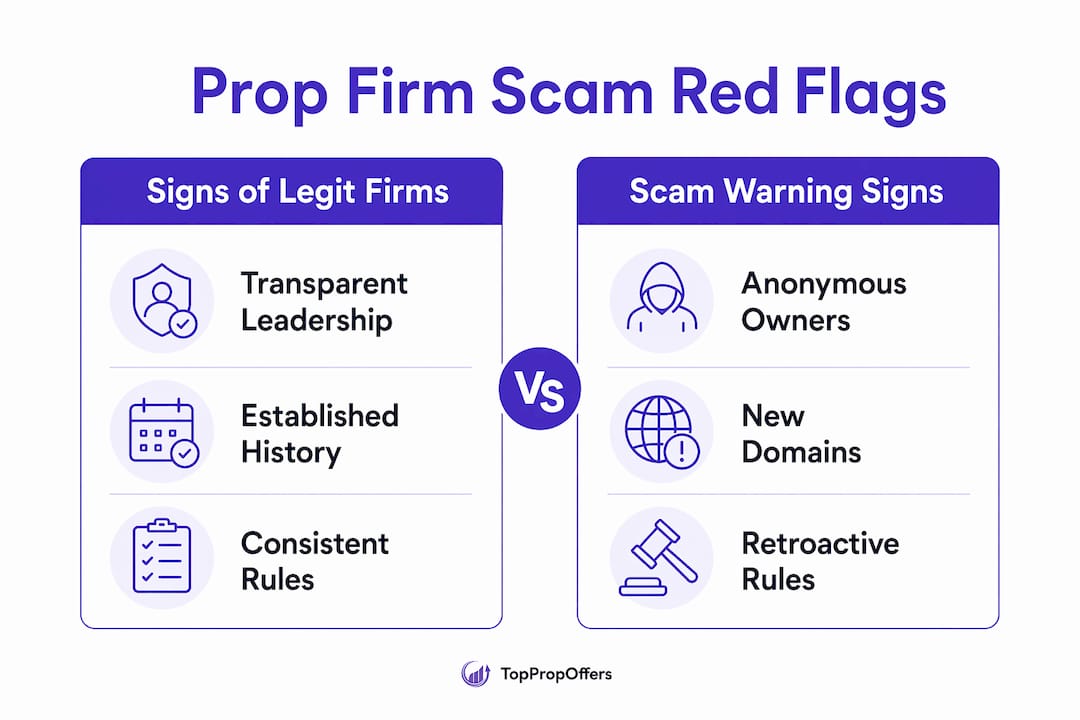
Firms with less than 12 months of operating history carry significantly higher scam risk, especially those selling “lifetime” funded accounts for over $1,000. A domain registered within the last six months is a concrete warning sign you can verify in minutes using a WHOIS lookup tool. New firms are not automatically fraudulent, but they have no track record to validate their payout claims.
Anonymous or unverifiable leadership
Legitimate prop firms name their founders and executives publicly. Unverifiable ownership is a strong red flag because firms hiding their leadership are far more likely to have payout issues. Search the CEO’s name on LinkedIn and cross-reference it with company registration records. If no real person is attached to the firm, treat it as a scam until proven otherwise.
Unrealistic promises and suspicious fee structures
No legitimate prop firm guarantees profits or promises “easy” funded accounts with no meaningful risk parameters. Watch for firms charging excessive upfront fees relative to the account size offered. The most dangerous fee of all is the “release fee,” a payment demanded after you have already earned profits. That demand is a guaranteed scam signal.
Poor communication and evasive support
Test a firm’s support before you pay anything. Send a detailed pre-sale question about drawdown rules, payout timelines, and withdrawal methods. Evasive, delayed, or scripted responses indicate the firm either lacks operational infrastructure or is deliberately avoiding accountability. Legitimate firms answer rule questions directly and in writing.
Retroactive rule changes
Retroactive rule shifting is the most toxic scam trend in 2026. Fraudulent firms change funded account rules after traders complete evaluations, then use vague new terms to deny payouts or close accounts. This tactic is designed to claw back profits while silencing traders with complex legal language. Differing evaluation and funded account rules also indicate an unsustainable business model.
Pro Tip: Filter Trustpilot reviews to one star before reading any firm’s overall rating. One-star reviews expose granular complaints about withdrawal delays and sudden terminations that a 4.2-star average completely hides.
How to thoroughly verify a prop firm before signing up
Use this checklist before committing any funds. Each step takes less than 30 minutes and can save you hundreds or thousands of dollars.
-
Check domain age. Run the firm’s domain through a WHOIS lookup. Any domain registered within the past six months warrants serious caution, particularly for firms offering high-value accounts.
-
Verify named leadership. Search the CEO and founding team on LinkedIn. Confirm their employment history is consistent and publicly visible. Firms hiding ownership are far more likely to have payout problems.
-
Search government registries. Look up the firm’s company registration number in the relevant national business registry. A registered legal entity with a verifiable address is a baseline requirement for trust.
-
Confirm published rules. Read the evaluation rules and funded account rules side by side. They must be consistent. Differences between the two documents signal the firm may use evaluation rules to attract traders and funded account rules to deny payouts.
-
Use the Wayback Machine. The Wayback Machine archives historical versions of web pages. Compare the firm’s current rules page against versions from three and six months ago. Quietly narrowed drawdown limits or newly added restrictions are a clear warning of rigged challenges.
-
Verify payout proof. Screenshots of numbers prove nothing. Verifiable payout proof requires a traceable payment processor reference, such as a Deel or Riseworks transaction ID, along with a date and amount. Firms with a public payout track record spanning at least 12 months meet the minimum standard.
-
Filter Trustpilot reviews. Ignore the overall score. Read the one-star reviews in detail. High volumes of complaints about payout delays or denials on Trustpilot, Reddit, or trading forums predict possible firm collapse or fraud.
-
Test pre-sale support. Ask a specific question about the funded account withdrawal process. Time the response and evaluate whether the answer is direct and documented. Evasive support before you pay is a reliable predictor of worse behavior after.
| Verification Step | What to Check | Risk Signal |
|---|---|---|
| Domain age | WHOIS registration date | Under 6 months old |
| Leadership | Named CEO with LinkedIn history | No verifiable identity |
| Company registration | National business registry | No legal entity found |
| Rule consistency | Evaluation vs. funded account rules | Differing terms |
| Payout proof | Processor ID, date, and amount | Screenshots only |
| Trustpilot one-star reviews | Withdrawal and termination complaints | Repeated payout denials |
Pro Tip: Firms that fail three or more points on a 10-point verification checklist carry statistically higher scam risk. Use the table above as your baseline checklist before paying any challenge fee.
What are effective strategies to protect your funds from prop firm fraud?
Preventing prop firm fraud requires active habits, not just one-time research. Apply these practices from the moment you engage with any firm.
-
Never pay a fee after earning profits. Any demand for a “release fee,” “verification fee,” or similar payment once you are in profit is a scam. Chargebacks are allowed within 60–90 days depending on your card issuer. File one immediately if you encounter this demand.
-
Document everything. Take screenshots of the rules page, your account dashboard, and every support conversation. Date-stamp your files. This documentation is your primary evidence if you need to file a chargeback or a formal complaint.
-
Avoid opaque withdrawal policies. If a firm’s withdrawal terms require multiple steps, unexplained waiting periods, or vague conditions, those terms exist to delay or deny payouts. Legitimate firms publish clear, simple withdrawal timelines.
-
Be skeptical of excessively easy accounts. Firms advertising instant funded accounts with no meaningful drawdown rules or profit targets are either unsustainable or fraudulent. Understanding how prop firms really work helps you recognize when an offer is too good to be true.
-
Report suspicious firms publicly. Post detailed accounts on Reddit’s r/Forex and r/PropFirms communities, Trustpilot, and trading forums. Public accountability deters fraud and protects other traders.
-
Use official complaint channels. If a firm is registered in a regulated jurisdiction, file a complaint with the relevant financial authority. Even unregulated firms can face payment processor sanctions if enough documented complaints accumulate.
“The single most protective habit a trader can develop is documenting every rule, every communication, and every account state before and after any significant event. Fraud thrives on the absence of evidence.”
How do legitimate prop firms manage risk and detect fraud?
Understanding what professional risk management looks like helps you distinguish trustworthy operators from fraudulent ones. Legitimate firms use automated risk engines to enforce drawdown limits, monitor trading patterns, and detect rule violations in real time. Manual enforcement causes delays and inconsistent punishments, which increases risk for both the firm and the trader.
Reputable firms also detect coordinated trading abuse, including multi-accounting, copy trading across accounts, and latency arbitrage, using layered evidence systems. Legitimate detection involves documented evidence and a clear explanation before any account action is taken. Firms that issue no-warning terminations with no appeal process and no documented reason are almost certainly operating as scams.
| Legitimate Firm Behavior | Scam Firm Behavior |
|---|---|
| Automated drawdown enforcement | Manual, inconsistent rule application |
| Documented appeals process | Immediate bans with no explanation |
| Consistent evaluation and funded rules | Rules that change after evaluation |
| Traceable payout records | Screenshots with no processor reference |
| Named leadership and registered entity | Anonymous ownership |
Pro Tip: Before signing up, ask the firm directly: “What is your appeals process if my account is flagged for rule violations?” A legitimate firm answers this question clearly. A scam firm deflects or ignores it.
Understanding hidden rules in prop firm challenges is equally important. Many fraudulent firms bury restrictive conditions in footnotes or update them quietly after traders pass evaluations.
Key Takeaways
Avoiding prop firm scams requires verifying domain age, leadership identity, rule consistency, and payout proof before committing any funds.
| Point | Details |
|---|---|
| Verify before you pay | Check domain age, company registration, and named leadership before any payment. |
| Retroactive rule changes are a scam signal | Use the Wayback Machine to confirm rules have not changed since the firm launched. |
| Release fees are always fraud | Any post-profit fee demand is a scam; file a chargeback within 60–90 days. |
| Filter Trustpilot by one star | Average ratings hide payout complaints; one-star reviews reveal the real picture. |
| Legitimate firms document enforcement | Real firms use automated risk engines and provide documented appeals, not sudden bans. |
The uncomfortable truth about prop firm due diligence
TopPropOffers Editorial Team
Most traders who lose money to prop firm scams did not skip research entirely. They read the homepage, checked the overall Trustpilot score, and saw a 4.3-star average. That felt like enough. It is not.
The firms that run the most effective scams invest heavily in surface-level credibility. They build professional websites, post fabricated payout screenshots on social media, and collect early positive reviews from traders who passed small challenges. The fraud only becomes visible when withdrawal requests hit a certain volume or when the firm decides to change its rules.
The traders who avoid these losses consistently do two things differently. First, they filter Trustpilot to one star and read every complaint in detail before they read anything else. Second, they use the Wayback Machine to check whether the firm’s rules page has changed in the past six months. These two steps take under 20 minutes and catch the majority of fraudulent operators.
The prop trading industry has legitimate, well-run firms that pay traders reliably. The best prop firms in 2026 are ranked by payout transparency and rule fairness, not by marketing budgets. Your job as a trader is to find those firms and ignore the rest. Patience before paying a challenge fee is not caution. It is discipline.
— TopPropOffers Editorial Team
Verified prop firms you can trust in 2026
Protecting your capital starts with choosing firms that have already passed rigorous independent review.
TopPropOffers reviews 80+ prop firms across forex, futures, and crypto markets, with every listing updated for 2026 verified payout data, current drawdown structures, and active promotional offers. You can compare challenge structures across 1-step, 2-step, and instant funding evaluations to find the format that fits your trading style. For traders who want a proven starting point, the FTMO review covers one of the most transparent firms in the industry, with documented payout records and consistent rules. WeMasterTrade is another verified option; use code TOPPROP30 for a discount on your first challenge. Access all verified prop firm discount codes in one place and save on enrollment fees at firms that have earned their reputation.
FAQ
What is a prop firm scam?
A prop firm scam is a fraudulent operation that collects challenge or evaluation fees with no genuine intention of funding traders or paying out profits. These firms often disappear after accumulating enough fee revenue.
How do I spot a fake prop firm?
Signs of a fake prop firm include anonymous ownership, domains registered within the past six months, demands for post-profit fees, and rules that change after you complete an evaluation.
Is a release fee always a scam?
Yes. Any fee demanded after you have already earned profits is a guaranteed scam signal. File a chargeback with your card issuer immediately, as most issuers allow disputes within 60–90 days.
How do I verify a prop firm’s payout proof?
Real payout proof includes a traceable payment processor reference such as a Deel or Riseworks transaction ID, along with a date and amount. Screenshots of numbers alone are not verifiable.
What is the Wayback Machine and why does it matter for prop firms?
The Wayback Machine archives historical versions of websites. Use it to compare a firm’s current rules page against older versions and detect whether drawdown limits or restrictions were quietly tightened after traders enrolled.