
Master Account Prop Firm Explained for Traders in 2026
TL;DR:
- A master-account prop firm routes trades from one central account into multiple funded sub-accounts, multiplying capital access. Passing evaluations grants conditional capital, with strict risk and compliance rules, and requires careful verification before scaling or trading. The model favors disciplined traders with proven strategies, as misconfigurations can lead to rapid account failures.
A master-account prop firm is a proprietary trading operation that routes trades from one centrally controlled “master” account into multiple funded sub-accounts, giving a trader shared access to firm capital under a single set of risk rules. The practical effect: one decision at the master level propagates instantly to every linked sub-account, multiplying both your exposure and your compliance risk at the same time. Passing an evaluation at these firms grants conditional access to capital, not unconditional live funds — a distinction that matters more than most challenge marketing suggests.
Who benefits most from this model:
- Traders who already run a consistent, rules-based strategy and want to scale buying power without managing separate accounts manually
- Experienced funded traders comfortable with trade copier software and position-sizing math
Who should be cautious:
- Traders still refining their strategy — a single bad trade replicates across every sub-account simultaneously
- Anyone considering routing an external signal provider into a funded master account (most firms prohibit this outright)
Pro Tip: Before your first live session on a master-account setup, place one small test trade and confirm the copier replicates correctly to every sub-account at the right lot ratio. A misconfigured sizing ratio is one of the most common technical errors that leads to immediate account closures — catching it on a micro trade costs almost nothing.
Table of Contents
- What a master account is and how it differs from standard funded accounts
- How evaluations and capital allocation work for master-account setups
- Risk rules, profit splits, and payout mechanics you need to understand
- Managing your funded allocation and scaling responsibly
- How to verify a master-account prop firm’s credibility before you apply
- Key Takeaways
- The master-account model rewards discipline, not just strategy
- TopPropOffers has verified reviews for master-account prop firms
- Where to learn more and verify what you read
- FAQ
What a master account is and how it differs from standard funded accounts
The architecture is straightforward once you see it clearly. A master account sits at the top of the structure: the trader executes all trades there. A trade copier (software running either on the firm’s infrastructure or a third-party tool) then replicates those trades to one or more sub-accounts, often called slave accounts, at a defined lot ratio. The firm controls the risk parameters at each sub-account level, including drawdown limits and position caps.
In a standard funded account model, you get one account, one set of rules, and one pool of buying power. The master-account model layers on top of that: the same trader controls multiple funded allocations through a single execution point. According to Interactive Brokers’ prop trader onboarding documentation, funds are deposited in the master account and transferred between master and sub-accounts to control individual trader limits, with each sub-account maintaining its own trading limits and strategy.
Key structural elements at a glance:
- Master account: Where all trade decisions originate; owned and controlled by the trader
- Sub-accounts (slave accounts): Receive replicated trades; each carries its own drawdown and position limits
- Trade copier: The software layer that propagates trades from master to sub-accounts at a configured lot ratio
- Firm control points: Risk rules enforced at the sub-account level, often independently of the master
The compliance line here is critical. Whether the master account is owned and controlled by the same trader is the single most important factor distinguishing a legitimate multi-account setup from a prohibited external signal arrangement. Many prop firms explicitly ban receiving external signals into a funded account — if your master account is fed by a third-party signal provider rather than your own decisions, you are almost certainly violating firm rules, regardless of how the copier is configured.
| Element | Master-account model | Standard funded account |
|---|---|---|
| Who owns the account | Same trader across all accounts | Single trader, one account |
| Where execution occurs | Master account only | Directly in the funded account |
| Capital structure | Pooled or sliced across sub-accounts | Single allocation |
| Drawdown tracking | Per sub-account and sometimes aggregated | Single account drawdown |
| Common restrictions | External signals prohibited; ratio limits | Standard drawdown and position rules |
| Compliance risk | Correlated breach across all sub-accounts | Isolated to one account |
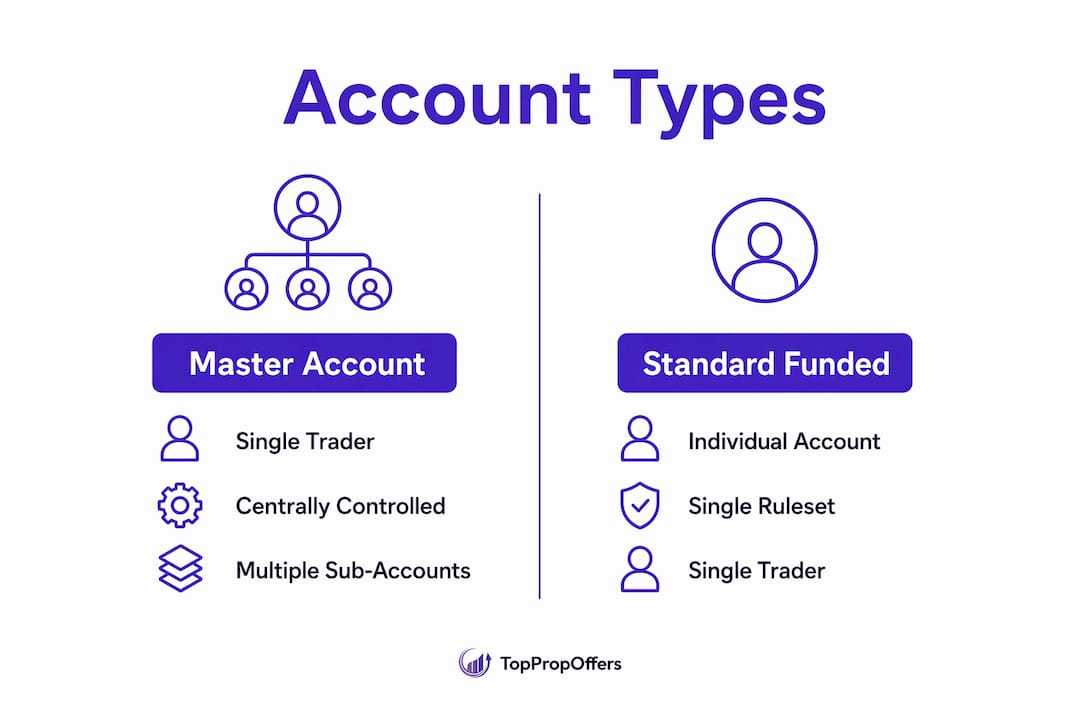
Account merging is a related concept some firms use: after a trader passes multiple evaluations, the firm consolidates the allocations into a single master structure that inherits aggregated capital while preserving individual risk parameters per sub-account.
How evaluations and capital allocation work for master-account setups
These evaluations are still filters. Passing one clears the first gate; it does not hand you unrestricted live capital. Many firms run funded stages under simulated or blended conditions, with post-pass review windows before continuous payouts begin. Understanding that sequence changes how you should approach the challenge.
The three common evaluation paths:
- 1-step evaluation: One phase with a single profit target (typically 8%–10%) and a max drawdown limit. Faster to complete, often slightly higher fee. Common for traders who want to move quickly to a funded allocation.
- 2-step evaluation: Phase 1 sets a higher profit target (around 8%–10%); Phase 2 reduces it (around 4%–5%) to confirm consistency. More time but lower overall risk of a rushed pass. Most common format across retail prop firms.
- Instant funding: No challenge phase — the trader pays a higher upfront fee and receives a funded account immediately, subject to the same ongoing risk rules. Useful for experienced traders who want to skip the evaluation entirely.
In a master-account context, a trader typically passes one or more evaluations and then requests that the firm configure a master/sub-account structure across the funded allocations. Some firms build this natively into their platform; others require a separate request and may impose additional limits on position sizes or minimum hold times that must propagate from master to each sub-account.
How capital is allocated after passing:
- The firm may grant a single master allocation (e.g., $100,000) that the trader subdivides into sub-accounts
- Alternatively, each passed evaluation becomes its own sub-account, with the master account serving as the execution hub
- Drawdown math applies per sub-account: a 5% max drawdown on a $50,000 sub-account means a $2,500 loss limit, independent of performance in other sub-accounts
| Evaluation type | Typical fee range | Profit target | Max drawdown | Time limit |
|---|---|---|---|---|
| 1-step challenge | Evaluation fee varies | Profit target set by firm | Drawdown limit set by firm | Time limit set by firm |
| 2-step challenge | Evaluation fee varies | Phase 1 and 2 profit targets set by firm | Drawdown limit set by firm | Time limits set by firm |
| Instant funding | Evaluation fee varies | Ongoing rules apply | Drawdown limits set by firm | No fixed time limit |
Retail-facing prop firms commonly charge evaluation fees in the $50–$700 range depending on account size, with funded buying power often ranging from $25,000 to $300,000 after passing.
Typical evaluation-to-funded flow:
- Pay the evaluation fee and receive a demo or simulated account
- Hit the profit target while staying within drawdown and daily loss limits
- Pass review (some firms add a verification window of 1–5 business days)
- Receive funded account credentials; request master/sub-account configuration if applicable
- Begin trading under live or blended conditions with ongoing risk rules enforced
Risk rules, profit splits, and payout mechanics you need to understand

Firms use strict risk stacks in master-account setups: daily loss limits, maximum drawdown caps, position size limits, and minimum hold-time rules. These apply across replicated accounts, which means a single execution error can breach limits on multiple sub-accounts simultaneously. That correlated breach risk is the defining operational hazard of this model.
Common rule categories and what they mean for master-account traders:
- Daily loss limit: A cap on how much you can lose in a single trading day, typically 4%–5% of the account balance. Breaching it on the master account can trigger a simultaneous breach on every sub-account receiving the same trade.
- Maximum drawdown: The total loss limit from the account’s peak or starting balance, usually 8%–12%. Tracked per sub-account; a bad run on one does not automatically close others, but correlated positions can drag all of them down together.
- Position size limits: Caps on lot sizes or contract counts per trade. In a master-account setup, the copier’s lot ratio must keep each sub-account within its individual position limit.
- Minimum hold time: Some firms require trades to be open for a minimum duration (often 1–2 minutes) to prevent high-frequency scalping. This rule must propagate correctly through the copier — a trade closed early on the master can close early on every sub-account.
- Minimum trading days: Most firms require a minimum number of active trading days (often 5–10) before a payout is eligible.
Profit splits at retail prop firms typically fall in the 70%–90% range, with the trader keeping the larger share. Payout timelines vary: some firms process within 24–48 hours of a request; others have weekly or bi-weekly cycles. Eligibility gates — minimum trading days, a clean rule record, and sometimes a minimum profit threshold — must all be met before a payout request is accepted.
Statistic callout: Retail prop firms commonly offer profit splits of 70%–90% to funded traders, with evaluation fees ranging from roughly $50 to $700 depending on account size and challenge type.
| Rule category | Typical range | Master-account implication |
|---|---|---|
| Daily loss limit | 4%–5% of balance | Breach replicates to all sub-accounts |
| Max drawdown | 8%–12% of balance | Tracked per sub-account independently |
| Position size cap | Varies by account size | Copier ratio must respect each sub-account’s limit |
| Minimum hold time | 1–2 minutes (firm-dependent) | Must propagate correctly through copier settings |
| Profit split | 70%–90% | Applied per funded account at payout |
| Minimum trading days | 5–10 days | Required before payout eligibility |
Managing your funded allocation and scaling responsibly
Managing a master-account allocation requires controls on position sizing, scaling rules, and a verification routine after the first live session. Skipping that verification is where most technical failures happen.
Daily and weekly operational checklist:
- Verify the copier’s lot ratio against each sub-account’s balance before the session opens
- Confirm that position size limits on each sub-account are not exceeded by the replicated trade
- Review trade logs after each session to confirm all sub-accounts received the correct fills
- Check minimum hold timers are being respected across all accounts, not just the master
- Monitor each sub-account’s drawdown independently — do not assume they move in lockstep
- Weekly: pull a consolidated P&L across all sub-accounts and compare against each account’s drawdown ceiling
Scaling in a master-account setup is a staged process. The general principle: master one account for at least 60 trading days of consistent performance before adding additional funded sub-accounts. Adding more sub-accounts before you have a stable track record compounds small errors across a larger capital base, which is the fastest way to lose multiple funded accounts at once.
When firms approve additional buying power, they typically review your trading history on existing funded accounts, check for rule violations, and may impose a scaled maximum position size on the expanded allocation. Some firms have formal scaling plans with defined milestones (e.g., reach a 10% gain on the current allocation to qualify for a 25% increase in buying power). Check the specific firm’s scaling policy on its TopPropOffers review page before assuming a standard path applies.

Pro Tip: Set your copier’s lot ratio so that the largest trade you would ever place on the master account stays within the position limit of your smallest sub-account. If your smallest sub-account is $25,000 and the position cap is 2 lots, configure the ratio so a 2-lot master trade replicates to no more than 2 lots on that sub-account — not proportionally more. Recalculate this ratio every time a sub-account balance changes significantly.
How to verify a master-account prop firm’s credibility before you apply
Use a short checklist of objective trust signals to vet any firm before you pay an evaluation fee. The information you need is available on each firm’s TopPropOffers review page and on the firm’s own website — you should never have to guess at the rules.
Verification checklist:
- Transparent rule page: The firm publishes its exact profit targets, drawdown limits, daily loss caps, and minimum trading days. If these are buried or vague, that is a red flag.
- Payout proofs: Look for verified payout screenshots or Trustpilot reviews that confirm real traders have received real payouts. Volume matters — a handful of reviews is not the same as hundreds of consistent ones.
- Copier and multi-account policy: The firm explicitly states whether master/sub-account setups are permitted, what copier software is allowed, and whether external signal providers are prohibited.
- Ratio and position limit documentation: The firm specifies how position limits apply across sub-accounts in a master setup. If this is not documented, ask in writing before paying.
- Third-party review presence: Check Trustpilot and trading communities for independent trader feedback. A firm with no third-party review presence warrants extra scrutiny.
- Discount code and fee transparency: Legitimate firms list their evaluation fees clearly and honor verified discount codes. TopPropOffers publishes confirmed codes for each firm.
Red flags specific to master-account firms:
- The firm allows or does not explicitly prohibit external signal providers feeding the master account
- Copier policies are not documented or are described only in vague terms
- The ratio math between master and sub-accounts is not explained, making it impossible to verify position limit compliance
- Payout proofs are only from the firm’s own social media, with no independent third-party confirmation
- The firm’s rule page changes frequently without a changelog or version date
For firm-specific verification, the TopPropOffers prop firm directory lists rule breakdowns, payout data, and confirmed discount codes for 80+ firms. Use it as your starting point before visiting any firm’s own website.
| Verification step | Where to check | What to look for |
|---|---|---|
| Rule transparency | Firm’s rule page + TopPropOffers review | Exact profit targets, drawdown, daily loss caps |
| Payout proofs | Trustpilot + TopPropOffers review | Volume of reviews, recency, payout amounts |
| Copier/multi-account policy | Firm’s FAQ or terms + TopPropOffers review | Explicit permission or prohibition |
| Discount codes | TopPropOffers review page | Confirmed active codes (e.g., TOPPROP) |
| Third-party reviews | Trustpilot, trading forums | Independent trader feedback, not firm-curated |
Key Takeaways
A master-account prop firm routes all trade execution through one centrally controlled account that replicates to multiple funded sub-accounts, multiplying both capital access and correlated breach risk under a single set of firm rules.
| Point | Details |
|---|---|
| Core definition | A master account executes trades centrally; a copier replicates them to funded sub-accounts under firm risk rules. |
| Correlated breach risk | One bad trade can breach daily loss or drawdown limits across every sub-account simultaneously. |
| Evaluation still required | Passing a challenge grants conditional capital access, not unrestricted live funds; post-pass review gates apply. |
| Scale staged, not fast | Master one funded account for at least 60 trading days before adding sub-accounts to avoid compounding errors. |
| TopPropOffers verification | Use TopPropOffers review pages to confirm rule transparency, payout proofs, and discount codes before applying to any firm. |
The master-account model rewards discipline, not just strategy
The master-account structure is genuinely useful for traders who have already proven consistency on a single funded account. What the model does not do is fix an inconsistent strategy — it amplifies it, in both directions. The traders who get into trouble are almost always the ones who move to a multi-sub-account setup before they have a stable, rule-compliant track record on even one funded account.
From reviewing dozens of firm policies and trader outcomes, the pattern that stands out most is the copier configuration error. A trader passes multiple evaluations, sets up the master correctly in terms of strategy, and then loses two or three funded accounts in the first week because the lot ratio was miscalculated. The fix is simple: one test trade, verify every sub-account, then trade normally. Most traders skip that step because they are eager to start. The ones who do not skip it rarely have that problem.
The compliance question around external signals is the other consistent issue. Some traders assume that routing a third-party signal into the master account is fine as long as they are “monitoring” it. Most firm terms do not make that distinction. If the signal originates outside the trader’s own analysis and execution, it is typically prohibited. Read the copier policy in writing before you configure anything.
TopPropOffers has verified reviews for master-account prop firms
TopPropOffers lists verified reviews, confirmed discount codes, and transparent rule breakdowns for firms that support master-account and multi-account trading models. If you are comparing firms before paying an evaluation fee, the review pages below are the fastest way to check the rules that actually matter.

Three firms worth reviewing for master-account setups:
- WeMasterTrade is built specifically around master-account trading. Use code TOPPROP30 for a discount on your evaluation fee.
- FTMO is one of the most established retail prop firms with detailed rule documentation. Note: FTMO has no discount code.
- Breakout Prop is worth reviewing for its account merge and scaling policies if you plan to run multiple funded allocations.
For a full comparison of 80+ firms, discount codes, and current rule breakdowns, visit TopPropOffers and use code TOPPROP at most firms to reduce your evaluation fee.
Where to learn more and verify what you read
TopPropOffers review pages are the primary resource for firm-level verification: each page summarizes profit splits, drawdown rules, payout speeds, and confirmed discount codes in one place. Start there before trusting any firm’s own marketing.
TopPropOffers resources:
- Risk management for funded traders — practical controls for protecting funded accounts in master-account setups
- How prop firms really work — explainer on evaluation stages, rule stacks, and business models
- WeMasterTrade review — firm-specific rules and TOPPROP30 code details
- FTMO review — rule breakdown and payout data (no discount code)
- Breakout Prop review — scaling and allocation policy details
For broader context on how proprietary trading firms allocate capital and enforce risk rules, the Wikipedia entry on proprietary trading provides a solid structural overview. For AI-assisted trade replication behavior and leaderboard data, the TradeAiFi leaderboard offers external context on algorithmic copy trade mechanics.
“Retail proprietary trading firms evaluate traders using demo or live accounts before allocating capital. Successful traders are compensated through a profit-sharing arrangement.” — Wikipedia, Proprietary trading
FAQ
What is a master account in prop trading?
A master account is the central execution account in a multi-account prop firm setup. All trades originate there and are replicated to linked sub-accounts via a trade copier, under the firm’s risk rules.
How much does a $50,000 prop firm account cost?
Evaluation fees for a $50,000 funded account typically range from $50 to $300 depending on the firm and challenge type (1-step, 2-step, or instant funding). Check each firm’s current fee on its TopPropOffers review page, as pricing changes frequently.
How does a master-account prop firm differ from a standard prop firm?
A standard prop firm gives you one funded account with one set of rules. A master-account firm lets you route trades from a single master account to multiple funded sub-accounts simultaneously, multiplying your capital exposure and your compliance risk.
What profit split can I expect from a prop firm?
Retail prop firms typically offer profit splits of 70%–90% to funded traders. The exact split depends on the firm, the account tier, and whether you are in an evaluation or a fully funded stage.
Can I use an external signal provider with a master account?
Most prop firms prohibit external signal providers feeding into a funded master account. The compliance requirement is that the master account must be owned and controlled by the same trader executing the strategy.
What happens if I breach a rule on the master account?
Because trades replicate at machine speed, a rule breach on the master account — such as exceeding the daily loss limit — can trigger simultaneous breaches across every linked sub-account. This is the primary risk of the master-account model.
How long should I trade one funded account before scaling to more sub-accounts?
At least 60 trading days of consistent, rule-compliant performance on a single funded account is the recommended baseline before adding additional sub-accounts. Scaling too early compounds small errors across a larger capital base.