
Real Capital Prop Firms in 2026: What Traders Must Know
What is a real capital prop firm?
A real capital prop firm is a financial company that funds traders with actual firm capital to trade live markets, then splits the profits based on performance. The firm bears the trading losses; the trader keeps a share of the gains. That arrangement is the core of proprietary trading, and it separates genuine prop firms from demo-only platforms that simulate results without any real money changing hands.
As of mid-2026, the global prop trading market is valued at approximately $20 billion, with over 2,000 active firms funding evaluated traders. That scale reflects how much demand exists from skilled traders who want institutional-level capital without institutional barriers.
Here is what defines a real capital prop firm:
- The firm deploys its own balance sheet, not client funds, to back trader accounts
- Traders operate under defined risk rules including daily loss limits and maximum drawdowns
- Profit splits are commonly structured to share a majority of profits with the trader after evaluation
- Losses from live trading are absorbed by the firm, not the trader’s personal account
- Capital allocation scales with demonstrated performance over time
The Volcker Rule ended most bank proprietary desks after the 2008 financial crisis, pushing the activity into independent retail-focused firms. Those firms now provide individual traders access to capital that was once reserved for institutional desks.
Pro Tip: “Real capital” does not always mean what the marketing says. Some firms use risk-managed simulations and call them live accounts. The true test is whether your execution connects to live market liquidity and whether payouts come from trading profits rather than primarily from evaluation fees.
How funding models and account types actually work
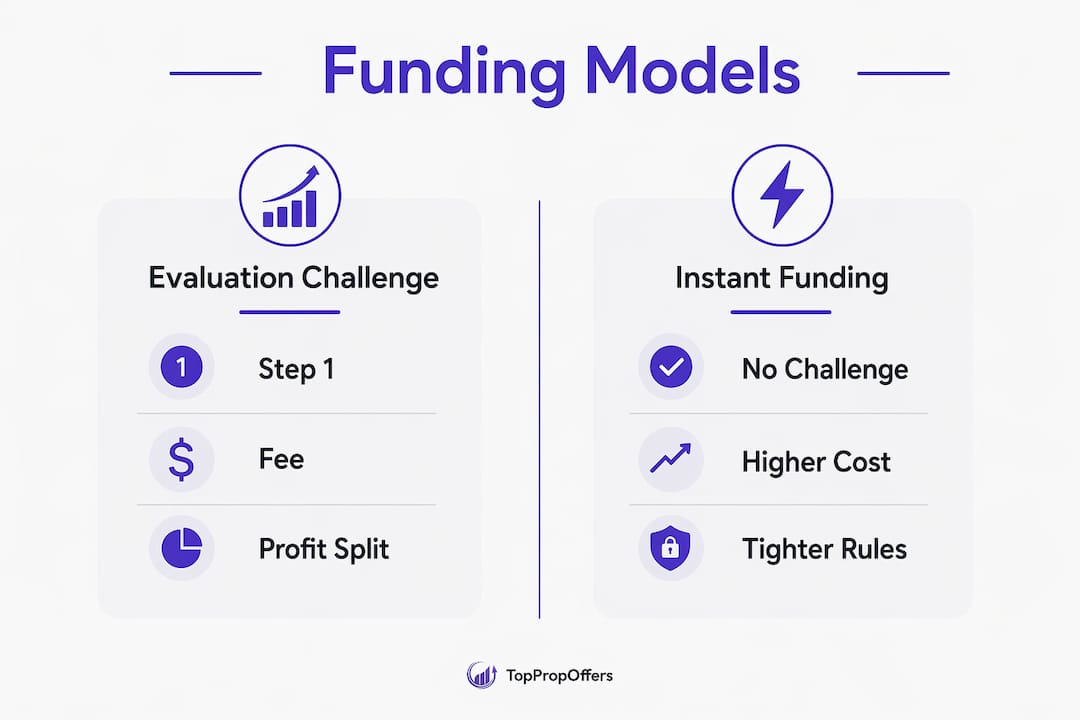
Most retail prop firms use one of two core models: the evaluation challenge or instant funding. Understanding which model a firm uses tells you a lot about how they manage risk and where their revenue comes from.

Most retail prop firms begin with simulated evaluation accounts before providing access to live trading capital after proven consistency. That demo-to-live transition protects the firm while filtering for traders who can perform under pressure.
| Model | Account Type | Evaluation Required | Typical Fee | Profit Split |
|---|---|---|---|---|
| 1-Step Challenge | Simulated, then live | Yes, one phase | $50–$700 | 70%–90% |
| 2-Step Challenge | Simulated, then live | Yes, two phases | $50–$700 | 70%–90% |
| Instant Funding | Live from day one | No challenge | Higher upfront | 50%–80% |
Evaluation fees typically range from $50 to $700 depending on account size, with profit targets around 6%–10% and strict loss limits. Pass the evaluation and you receive a funded account, often ranging from $25,000 to $300,000 in buying power. Fail by hitting the drawdown limit and you lose the fee.
Instant funding skips the challenge phase but usually costs more upfront and may carry tighter risk parameters. It suits experienced traders who want to start trading live capital immediately rather than proving themselves through a multi-phase process. You can compare challenge types across 1-step, 2-step, and instant funding structures to find what fits your trading style.
Funding tiers, drawdowns, and payout structures explained
Funded account sizes vary widely across the industry, but most firms offer tiered structures that let traders scale up as they prove consistency. Account sizes and risk parameters vary by firm and trading account. Common risk controls include daily loss limits, maximum drawdowns, profit targets required to pass evaluations, payout timing schedules, and profit splits that favor traders. Specific percentages and thresholds differ across the industry.

Fee structures matter beyond the initial evaluation cost. Some firms charge monthly platform fees, reset fees if you breach a limit, or scaling fees to access higher tiers. Read the full fee schedule before you commit. A firm with a lower evaluation fee but hidden monthly costs can end up more expensive than one with a higher upfront price and no recurring charges.
Payout reliability is where many firms fall short. Transparent payout history and documented trader payments are the best way to vet a prop firm’s legitimacy rather than relying on marketing claims alone.
Key risk rules you must follow with a real capital prop firm
Risk rules are not suggestions. Violate them and your funded account closes, regardless of your overall profitability. Every real capital prop firm enforces a set of non-negotiable parameters designed to protect firm capital from catastrophic loss.
Common risk controls across the industry include:
- Daily loss limit: Breaching this in a single session terminates the account immediately at most firms
- Maximum drawdown: Measured from peak equity or starting balance depending on the firm’s structure
- Position size limits: Caps on lot sizes or contract counts prevent outsized exposure on any single trade
- Consistency rules: Some firms require that no single day’s profit exceeds a set percentage of total gains
- News event restrictions: Holding trades through major economic releases (like Non-Farm Payrolls) is prohibited at many firms
- Prohibited instruments: Certain assets, including some crypto pairs or exotic currencies, may be off-limits
Prop firms impose daily loss limits and max drawdowns to protect capital and maintain proper risk management. The consequence of ignoring these rules is straightforward: you lose the funded account and must restart the evaluation process, paying the fee again.
Discipline in risk rule adherence is the main factor separating traders who transition successfully from simulated evaluation to funded live trading. Traders who treat the rules as obstacles rather than guardrails rarely make it past the first funded cycle.
How to vet a real capital prop firm before you join
Not every firm calling itself a “real capital” provider actually operates with live market execution. Some use simulated payouts funded by evaluation fees, which is a legitimate model but not the same as direct live funding. Knowing the difference protects your time and money.
Use these criteria when evaluating any firm:
- Broker relationships: Does the firm name its liquidity provider or executing broker? Reputable firms are transparent about where trades are routed.
- Execution quality: Live market connectivity means your orders interact with real liquidity. Ask whether funded accounts use live or simulated execution.
- Payout proof: Look for verified withdrawal records from real traders, not just screenshots on the firm’s own website. Third-party communities and review platforms carry more weight.
- Business model balance: The firm’s revenue comes from its share of profitable traders’ gains and from evaluation fees. A firm that pays out consistently has healthier incentives than one that profits mainly from failed challenges.
- Trader support: Does the firm offer mentoring, education, or dedicated account management? These resources signal that the firm wants traders to succeed, not just collect fees.
- Rule transparency: All drawdown rules, payout schedules, and fee structures should be documented clearly before you pay anything.
For a deeper look at what separates reliable firms from unreliable ones, the prop firm payout rejection guide at TopPropOffers covers the seven most common reasons payouts get denied and how to avoid each one.
Building your path to funding with a real capital prop firm
Getting funded is a process, not a single event. Most traders who succeed treat the evaluation phase as a structured performance test rather than a shortcut to capital.
A typical path looks like this:
- Choose the right account size. Start with a tier you can hit the profit target on without overtrading. A $25,000 account with a 10% target requires $2,500 in gains, which is achievable with disciplined position sizing.
- Trade the evaluation exactly as you would trade live. The biggest mistake traders make is switching strategies under pressure. If your edge does not work in the evaluation, it will not work with real capital either.
- Respect every risk parameter from day one. Traders risk losing their non-refundable evaluation fees if they breach the challenge rules, so treat each session as if the account is already funded.
- Transition carefully from simulated to live. The psychological shift from demo to live capital is real. Slippage, spread costs, and execution speed may differ slightly, and emotional pressure increases.
- Scale methodically. Skilled traders gain access to larger capital pools quickly after evaluation, enabling greater market exposure without risking personal funds. Use scaling plans to grow your allocation rather than jumping to the highest tier immediately.
Comparing your options against a personal trading account is worth doing before you commit. Prop firm capital removes personal financial risk from your trades, but it adds rule constraints that a self-funded account does not carry.
Examples of reputable real capital prop firms worth considering
The firms below are reviewed and tracked by TopPropOffers across payout data, rule transparency, and trader feedback. Each has a distinct profile that suits different trading styles.
Breakout Prop stands out for its straightforward rule set and live capital funding structure. Traders who prefer clarity over complexity tend to do well here. Use code TOPPROP for a discount on your evaluation fee.
FTMO is one of the most established names in the industry, known for detailed performance reporting and consistent payouts. Note that FTMO does not offer a discount code through TopPropOffers.
FundedNext offers both challenge-based and instant funding paths, with profit splits that scale as you grow your account. Use code TOPPROP on your evaluation.
FXIFY appeals to forex-focused traders with competitive drawdown rules and a clean evaluation structure. Code TOPPROP applies.
E8 Markets runs a two-phase evaluation with clear scaling milestones and strong payout documentation. Use code TOPPROP for savings on your challenge fee.
WeMasterTrade suits traders who want community support alongside their funded account. Use code TOPPROP30 for this firm specifically.
FundingPips offers competitive profit splits and a straightforward challenge structure for forex and commodity traders. Code TOPPROP applies.
For a full ranked list with verified 2026 payout data and current rules, the best prop firms in 2026 guide at TopPropOffers covers 80+ firms with side-by-side comparisons.
Trader support and resources that separate good firms from great ones
The quality of support a prop firm provides often predicts whether traders succeed long-term. Capital access alone is not enough if you are trading in isolation without feedback or tools.
The best real capital prop firms offer several layers of support:
- Mentoring and coaching: Some firms provide access to senior traders or structured coaching programs. This is especially valuable during the transition from evaluation to live funded trading.
- Educational resources: Video libraries, webinars, and written guides on risk management, strategy development, and psychological discipline help traders build durable skills.
- Trading technology: Access to professional platforms like MetaTrader 4, MetaTrader 5, or cTrader gives traders the execution quality and charting depth they need. Some firms also provide proprietary dashboards showing real-time drawdown usage and performance metrics.
- Community access: Active trader communities, Discord servers, and forums let funded traders share setups, discuss rule interpretations, and support each other through drawdown periods.
- Account management: Dedicated support staff who can answer rule questions quickly reduce costly misunderstandings about what is and is not permitted.
Third-party capital partners enable some firms to offer larger buying power, but this can affect liquidity and payout timelines. Ask any firm you are considering whether payouts come from trading profits or from evaluation fee revenue, and how third-party arrangements affect your withdrawal timeline.
For a thorough breakdown of how prop firm funding models, account types, and payouts actually work, the prop firm mechanics guide at TopPropOffers covers the operational details most firms do not advertise clearly.
Key Takeaways
A real capital prop firm funds traders with actual firm capital under strict risk rules, sharing profits while absorbing trading losses, with profit splits typically ranging from 70% to 90% in the trader’s favor.
| Point | Details |
|---|---|
| Real capital vs. simulated | Live funded accounts connect to real liquidity; evaluation accounts are typically simulated demo environments. |
| Evaluation fee range | Fees run $50–$700 depending on account size, with profit targets of 6%–10% required to pass. |
| Profit split structure | Most retail prop firms offer 70%–90% splits in the trader’s favor after passing evaluation. |
| Risk rule compliance | Daily loss limits and max drawdowns are non-negotiable; breaching either closes the funded account immediately. |
| Vetting a firm | Verified payout records and transparent broker relationships are the strongest trust signals to check before joining. |
FAQ
What is a real capital prop firm?
A real capital prop firm funds traders with the firm’s own money to trade live markets, sharing profits based on performance while absorbing trading losses. It differs from demo-only platforms because actual firm capital is at risk on funded accounts.
Do prop firms pay real money to traders?
Yes, reputable prop firms pay real withdrawals to funded traders, typically on weekly or bi-weekly cycles. Verified payout records from third-party sources are the most reliable way to confirm a firm actually pays.
How much does a prop firm evaluation cost?
Evaluation fees typically range from $50 to $700 depending on the account size you choose. Failing the challenge means losing that fee, since it is non-refundable at most firms.
Is prop trading legal?
Prop trading is legal in the United States and most major markets. Retail prop firms operate as private companies funding their own capital, which places them outside the regulatory framework that governs client-fund managers like brokers or investment advisors.
What profit split can I expect from a funded account?
Most retail prop firms offer profit splits of 70%–90% in the trader’s favor after passing evaluation. The exact split depends on the firm and the account tier you hold.

Ready to find a real capital prop firm that fits your trading style? TopPropOffers reviews 80+ prop firms with verified 2026 payout data, transparent rule breakdowns, and exclusive discount codes. Use code TOPPROP at most firms to save on your evaluation fee. Visit TopPropOffers to compare your options and start your path to funded trading today.