
Funded Account Trading Psychology: Master Your Mindset
Funded account trading psychology is the make-or-break factor that separates traders who keep their capital from those who blow accounts within weeks of passing a challenge. Most traders spend months perfecting entries and exits, then lose their funded account not because their strategy failed, but because their mind did. The rules, the drawdown limits, the profit targets, and the weight of trading capital that is not technically yours create a pressure cooker that exposes every psychological weakness you have. This article gives you the mental frameworks, routines, and hard truths you need to stay funded.
Table of Contents
- Key Takeaways
- Funded account trading psychology: the foundational shift
- Psychological traps that cause funded traders to fail
- Practical strategies for emotional control in trading
- Managing the transition from evaluation to funded
- My honest take on what actually matters
- Find the right challenge for your trading mindset
- FAQ
Key Takeaways
| Point | Details |
|---|---|
| Mindset shift is non-negotiable | Moving from retail to funded trading requires a fundamental identity shift, not just a rule adjustment. |
| Trailing drawdown creates unique pressure | Understanding how the equity floor rises with profits helps you manage the psychological threat it creates. |
| Tilt is the top account killer | Recognizing early emotional flooding signs prevents reckless trades that blow funded accounts fast. |
| Pre-trade routines protect discipline | Structured mental state checks and hard session rules reduce emotionally driven decision-making under stress. |
| Post-funding overconfidence is real | Switching from evaluation mode to capital preservation mindset is the most overlooked funded trading skill. |
Funded account trading psychology: the foundational shift
Most traders entering their first funded account underestimate how different the psychological environment is compared to retail or demo trading. Account sizes from $50k to $200k, combined with profit targets of 8 to 10% and drawdown limits of 5 to 10%, create a completely different mental landscape. You are no longer just managing risk. You are managing rules, identity, and the very real fear of binary failure.
The first major shift is identity. When you trade your own money, a loss is frustrating. When you trade funded capital, a loss feels like personal failure on a graded exam. This is not just semantics. Behavioral mistakes under stress cause more trading failures than flawed strategies, and the funded environment amplifies stress in ways retail trading never does.
During the evaluation phase, many traders slip into a sprint mentality. They push hard, take slightly bigger risks, and treat the challenge like a deadline project. Pass or fail. Once funded, the smart move is a marathon mentality: consistent, measured, focused on preservation. Traders who never make that switch are the ones who blow accounts in the first month after funding.
Several cognitive biases show up repeatedly in funded trading:
- Loss aversion: The pain of losing a trade feels roughly twice as intense as the pleasure of winning the same amount, which causes premature profit-taking and holding losers too long.
- Recency effect: A string of wins makes you feel invincible. Two consecutive losses make the entire strategy feel broken. Neither emotional reading is accurate.
- Confirmation bias: You see setups that confirm you should trade, even when the honest read of the chart says wait.
“The funded account challenge is fundamentally won inside the trader’s head. Decision-making under pressure is the skill being tested, not strategy alone.”
Understanding how prop firm challenges are structured is the first step toward managing the unique pressure they create.
Psychological traps that cause funded traders to fail
The trailing drawdown trap
The trailing drawdown is one of the most psychologically punishing rules in prop trading, and most traders do not fully internalize what it does to their mental state until they experience it live. Unlike a static drawdown, a trailing drawdown moves upward with your account equity, dragging the liquidation threshold higher every time you make money. That means even a strong winning session can leave you more vulnerable to termination if you give those profits back.

This creates a persistent psychological threat. You win three trades in a row, and instead of feeling more secure, the floor beneath you has risen. Profit retracements can trigger termination because the high-water mark keeps moving up, punishing any trader who does not lock in gains consistently. The result is anxiety during winning streaks, not just losing ones. That is genuinely counterintuitive, and it catches even experienced traders off guard.
The house money effect
After getting funded, many traders unconsciously treat the prop firm’s capital as “free money.” This is called the house money effect: traders emotionally detach from the reality of funded capital, start sizing up, bending rules, and taking trades they would never have taken during evaluation. The logic sounds harmless. “It is not my money anyway.” But the outcome is almost always the same: discipline erodes, drawdown accumulates, and the account gets pulled.
Here is a comparison of how the house money effect changes trading behavior before and after funding:
| Behavior | During evaluation | After funding (house money effect) |
|---|---|---|
| Risk per trade | Strictly controlled | Gradually increases |
| Strategy adherence | High | Starts bending |
| Trade frequency | Selective | Increases impulsively |
| Drawdown awareness | Constant | Diminishes with confidence |
Pro Tip: Treat your funded account capital with the same emotional weight as your own savings. Write the dollar amount of your drawdown limit on a sticky note next to your screen. Concrete numbers fight abstract detachment.
Tilt and the emotional cycle
Tilt is the top cause of fund loss in prop trading. It follows a predictable cycle: a losing trade creates frustration (Fear), which builds into agitation (Tilt), which leads to impulsive position sizing and strategy deviation (Emotional Trading), and finally to complete loss of discipline (Full Tilt). Recognizing which stage you are in during a live session is a skill that takes deliberate practice. Most traders only realize they were in tilt after the damage is done.
There is also a lesser-discussed phenomenon called the “vise effect.” After funding, traders feel squeezed from both sides: the fear of blowing the account on one side, and the pressure to generate payouts on the other. This fear of success, paradoxically, makes traders second-guess high-probability setups and exit too early, which erodes performance just as reliably as overtrading does.
Practical strategies for emotional control in trading
Managing the mental side of funded trading is not a soft skill. It is a system. Here is a structured approach that works:
- Run a pre-trade mental state check. Before opening any position, rate your emotional state on a scale of 1 to 10. Anything above a 7 in agitation or below a 4 in focus should trigger a mandatory waiting period of at least 15 minutes. This sounds simple because it is. Simple rules work under pressure.
- Set hard session rules and honor them without negotiation. Stopping after 2 consecutive losses is one of the most studied and effective rules in prop trading psychology. It interrupts the tilt cycle before it reaches Full Tilt. You do not revisit the rule mid-session. It is pre-committed.
- Journal every trade with an emotional tag. Write down your emotional state when you entered, when you exited, and what was happening internally when you deviated from your plan. Revenge trades perform significantly worse than planned trades, and journaling with emotional tags is the fastest way to identify your personal tilt triggers.
- Size your positions in relation to your drawdown limit, not your profit target. Many traders size based on how much they want to make. The psychologically safer approach is to size based on how much buffer you have left in your drawdown. Use a forex drawdown calculator to stay anchored to real numbers.
- Run a mental reset after both wins and losses. Wins are dangerous because they breed overconfidence. After a profitable session, do a 5-minute checklist: Did I follow my plan? Did I honor my rules? Did I respect sizing? This prevents the “I’m on a roll” mentality that precedes most house money effect failures.
Pro Tip: Financial stress affects decision-making quality in measurable ways. Traders who carry external financial pressure into sessions make systematically worse risk decisions. Separate your living expenses from trading income mentally before every session.
Managing the transition from evaluation to funded
Passing a funded account challenge triggers one of two dangerous post-pass mindsets. The first is overconfidence: you proved you could do it, so you loosen the rules slightly, trade more frequently, and forget that the evaluation conditions were the ones that actually worked. The second is risk-averse paralysis: you are so afraid of losing the account that you exit profitable trades too early, miss setups, and underperform the very strategy that got you funded.
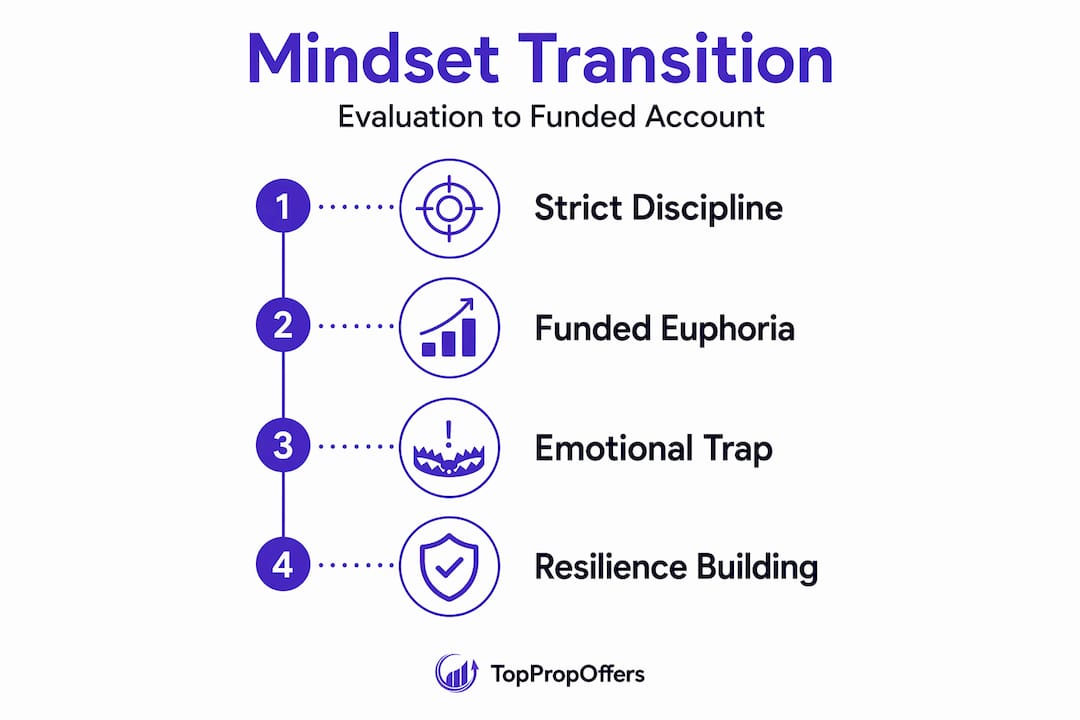
The most practical solution is deceptively simple: keep trading exactly as you did during the evaluation phase. This is what traders who succeed long-term actually do. The funded phase is not a promotion. It is a continuation.
Key behavioral adjustments that protect funded accounts over time:
- Decouple your identity from results. Your worth as a trader is not determined by this week’s P&L. Accounts that fail teach as much as accounts that succeed if you review them honestly.
- Focus on process, not payouts. Consistency rules at most prop firms determine payout eligibility anyway. The process that produces consistent results is what generates income over time.
- Invest in physical health deliberately. Sleep deprivation reduces prefrontal cortex function by 30 to 40%, which is the exact brain region responsible for impulse control and risk judgment. Sleep is not optional for a funded trader. Neither is regular exercise, which measurably improves focus-related brain factors.
- Build accountability into your routine. Whether that is a trading community, a mentor, or a weekly review partner, external accountability catches blind spots that solo journaling misses.
- Learn why traders fail challenges before the mistakes happen to you, not after.
Drawdowns feel permanent even when they are mathematically temporary. Building the resilience to sit through a drawdown without abandoning a working strategy is the defining skill of a long-term funded trader.
My honest take on what actually matters
I have spent years watching traders pass evaluations and then self-destruct within weeks. The pattern is almost always the same. It is not the strategy. It is the identity.
When a trader ties their self-worth to their funded account, every drawdown becomes an existential threat. That emotional weight makes rational decision-making nearly impossible. The traders who stay funded longest are the ones who see themselves as process managers, not performance heroes. They are not excited to win. They are committed to executing correctly.
What I have found genuinely counterintuitive is this: your most dangerous trading days are your best ones. When you are up significantly on the day, the brain shifts into reward-seeking mode. Risk management loosens. You start looking for more setups that are not actually there. I have seen more accounts damaged in the hour after a strong morning than during any tough stretch of losses.
The uncomfortable truth is that most funded trader failures are really identity crises wearing the costume of trading mistakes. Tilt, overconfidence, and paralysis all have the same root: the trader stopped following the process and started chasing the feeling of being right. Emotional regulation is not a nice addition to your trading toolkit. It is the foundation everything else rests on.
— TopPropOffers
Find the right challenge for your trading mindset
Choosing a prop trading challenge that matches your psychological profile matters more than most traders realize. A high-pressure 1-step challenge with a tight drawdown might be the fastest path to funding, but it is also the fastest path to blowing an account if your emotional control is still developing.

At Toppropoffers, we compare prop trading challenges across formats so you can make a decision based on real structure, real rules, and what actually fits your risk tolerance and mindset. Whether you are drawn to a 1-step, 2-step, or instant funding model, you can compare prop challenges side by side, filter by drawdown type, and find exclusive discount codes to reduce your enrollment cost. We also publish independent reviews of funded trading programs so you know exactly what you are signing up for before you commit. The right starting conditions make the psychological work significantly easier.
FAQ
What is funded account trading psychology?
Funded account trading psychology refers to the mental and emotional strategies traders use to manage the unique pressures of trading prop firm capital, including strict drawdown limits, profit targets, and fear of losing access to funding.
Why do funded traders fail after passing the evaluation?
Most post-pass failures come from a mindset switch: traders shift from disciplined evaluation behavior to either overconfidence or risk-averse paralysis. Maintaining the exact process used during evaluation is the most reliable protection against this.
How does the trailing drawdown affect trader psychology?
The trailing drawdown raises the liquidation floor as profits accumulate, meaning even profitable sessions create psychological pressure. Traders feel squeezed during winning streaks, not just losing ones, which is a unique mental challenge compared to retail trading.
What is the best way to prevent tilt in funded trading?
Pre-committing to hard session rules before trading, such as stopping after two consecutive losses, is one of the most effective tilt prevention strategies. Journaling trades with emotional tags also helps identify personal tilt patterns over time.
How does physical health affect funded trading performance?
Sleep deprivation reduces prefrontal cortex function by 30 to 40%, directly impairing impulse control and risk judgment. Regular sleep and exercise are not optional lifestyle choices for funded traders. They are performance inputs.
Recommended
- Alpha Capital Group Funded Account | Top Prop Offers
- Why Most Traders Fail Funded Account Challenges (And How to Avoid It) | Top Prop Offers
- Funded Trader Markets Review 2026 + Discount Code TOPPROP | TopPropOffers
- My Crypto Funding Review: The Best Crypto Prop Firm for Funded Crypto Trading Accounts | Top Prop Offers