
Prop Firm Account Upgrade Process: 2026 Playbook
Most funded traders qualify for an account upgrade after demonstrating consistent live profitability across a minimum period of trading days with no drawdown breaches. That is the short answer. The full picture involves three gates every firm checks before granting a larger allocation: a profit threshold (typically 8%–10% of account size), a minimum number of qualifying trading days, and a clean compliance record with no rule violations.
Before you do anything else, here are the immediate facts that matter:
- Profit threshold: Most firms require a profit target of starting account size in realized profits before a scale is approved.
- Minimum trading days: Common gates vary by firm; a higher number of days means a stronger statistical case for consistency.
- Drawdown compliance: A single breach of your daily or maximum drawdown limit typically voids scaling eligibility entirely, with no appeal.
- KYC and activation: After passing a prop firm challenge, accounts undergo a 1–3 day audit. KYC must be complete and any activation fee paid before funded trading begins.
- Rule changes at funding: Funded accounts frequently enforce stricter drawdown rules than the evaluation, including switches from end-of-day trailing to intraday trailing drawdown.
Your first 72 hours after funding should be spent completing KYC, reading the funded agreement in full, and taking a screenshot of your starting equity and platform settings. Do not place a single trade until you know exactly which rules govern your funded account, because they are often different from the evaluation rules you just passed.
Table of Contents
- How do prop firm scaling programs actually work?
- What profit targets and timelines do you actually need to hit?
- What performance metrics do prop firms actually evaluate?
- Step-by-step: from funded account to allocation increase
- How do top firms handle scaling in 2026?
- Practical strategies that improve your upgrade probability
- Common pitfalls that block or delay your upgrade
- Key Takeaways
- What funded traders actually get right about scaling
- Where to find verified scaling rules and current offers
- TopPropOffers pages to verify rules and scaling plans
- FAQ
How do prop firm scaling programs actually work?
Scaling is not a single process. Prop firms use several distinct models, and knowing which one your firm uses determines your entire upgrade strategy.
Automatic scaling is the simplest. You hit a predefined profit target over a set number of days, and the firm increases your allocation without any application. Many firms targeting active retail traders use this model because it reduces administrative friction.
Manual upgrade (application-based) requires you to submit a request, often with supporting documentation such as a trade history export or a brief cover note. The firm’s risk team reviews your record and responds within a few business days. This model is more common at firms that manage larger allocations or run institutional-style programs.
Challenge upgrades let you move to a larger account size while still in the evaluation phase. The mechanics are specific: the upgrade is typically available only during Phase 1, only realized profits carry over proportionally, and any open trades at the time of upgrade are excluded from the profit calculation. If you are considering this route, confirm the exact eligibility window with your firm before acting, since the carryover rules vary.
Parallel accounts (multi-account scaling) let experienced traders run multiple funded accounts simultaneously. FTMO, for example, allows up to $400,000 per strategy across multiple accounts. Each account must be traded independently. Running identical trades across accounts can trigger a violation for account sharing, even if no single account breaches its own rules.
The single most important early adjustment funded traders make: Re-read the funded agreement’s drawdown section before placing trade one. Switches from end-of-day to intraday trailing drawdown are the most common cause of funded-account failures after passing the evaluation, and most traders do not notice the change until it is too late.
Pro Tip: When your firm uses automatic scaling, set a calendar reminder for your eligibility date. Firms do not always notify traders proactively, and missing an activation window can delay your upgrade by a full review cycle.
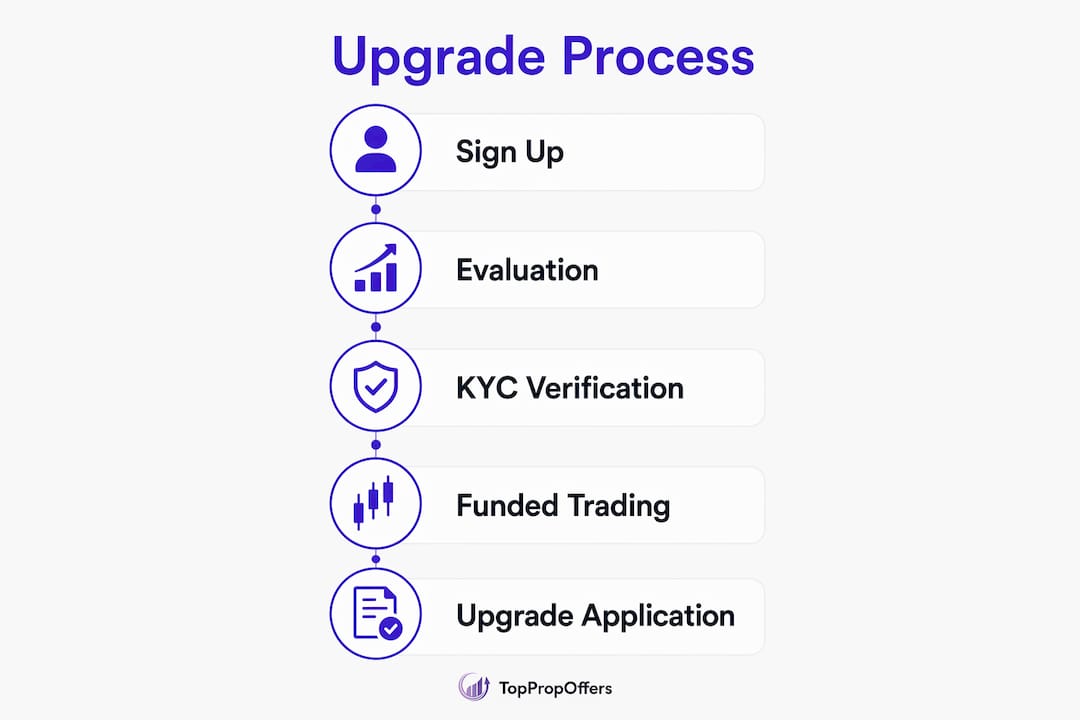
The funded account lifecycle follows a consistent sequence: signup, evaluation, KYC and verification, funded trading, payouts, and then scaling opportunities. Some firms add a phased funded-account model where initial accounts carry additional restrictions. A “CASH” or restricted status may require multiple payouts or a cumulative payout threshold before you unlock “LIVE” status and full scaling eligibility. Know which tier you are on before you calculate your upgrade timeline.

What profit targets and timelines do you actually need to hit?
The ranges below reflect what TopPropOffers sees across the 80+ firms reviewed on the platform. They are starting points for self-assessment, not universal rules. Always verify the exact figures on your firm’s review page.
Typical profit thresholds by account size
| Account size | Common profit target (%) |
|---|---|
| $10,000 | 8%-10% |
| $25,000 | 8%-10% |
| $50,000 | 8%-10% |
| $100,000 | 10% (evaluation phase), 8%–10% (funded phase) |
| $150,000 | 7%-8% |
| $200,000 | 6%-7% |
Profit targets as a percentage tend to decrease slightly as account size grows, with evaluation-phase targets commonly at 10% and funded-phase targets reduced for larger accounts based on TopPropOffers data.
Minimum trading days and review cadence
Most firms set a minimum number of qualifying trading days before a scale is considered. Some allow upgrades relatively quickly if strict conditions are met, but a longer period of live profitability builds a stronger statistical case for consistency. A 30-day record can look like a lucky streak. A 60-day record is harder to dismiss.
Payout eligibility and upgrade eligibility are not the same thing. You may be able to withdraw profits after 14 days while the upgrade gate requires 30 or 60 days of trading. Do not confuse the two timelines.
Drawdown mechanics that block scaling
Three drawdown structures appear across most firms, and each affects your upgrade eligibility differently:
- Static (end-of-day) drawdown: Calculated on your account’s starting balance. It does not move as your account grows. This is the most forgiving structure for scaling because a profitable run does not tighten your floor.
- Trailing drawdown: Follows your peak equity. As your account grows, the drawdown floor rises with it. A strong run followed by a pullback can breach the trailing floor even if you are still net profitable.
- Intraday trailing drawdown: The strictest version. The floor updates in real time during the trading session, not just at end-of-day. A position that goes against you intraday can breach the limit even if you close the day flat or positive.
The most common funded-account failure pattern: A trader passes the evaluation under end-of-day trailing drawdown rules, then discovers the funded account uses intraday trailing. The first volatile session wipes the account before they realize the rules changed.
Warning: Some firms reset your scaling eligibility clock if you trigger a drawdown warning, even without a full breach. Check whether your firm has a “soft breach” policy before you size up.
Timing traps to avoid: activating an upgrade before your minimum trading days are complete, missing the activation window after approval (some firms give you 48–72 hours to accept), and misreading fee-refund rules that only apply to specific challenge types.
What performance metrics do prop firms actually evaluate?
Profitability alone does not get you an upgrade. Firms evaluate a combination of quantitative metrics and behavioral patterns. Understanding what they look for lets you build a record that speaks for itself.
Core metrics every funded trader should track
- Maximum drawdown: Distance from your peak equity to your current equity. Track this daily, not just at session end.
- Daily loss: Your worst single-day loss as a percentage of account equity. Many firms set limits to control drawdown risks.
- Win rate: The percentage of trades that close profitably. A high win rate with small winners and large losers is a red flag. Firms look at win rate alongside average trade size.
- Average trade (expectancy): Average profit or loss per trade, accounting for both winners and losers. Positive expectancy over a large sample is what firms want to see.
- Trade frequency: How many trades you place per day or week. Erratic frequency (10 trades one day, 0 the next) raises questions about strategy consistency.
- Average position size as a percentage of equity: This should stay consistent. A sudden 5x increase in position size on a single trade is a behavioral red flag at firms managing scaled accounts above $100,000.
Position sizing after funding
Most firms expect you to risk a small percentage of account equity per trade, commonly less than 1%. After funding, recalculate this in dollar terms every time your account balance changes. If you were risking 1% on a $50,000 account ($500 per trade), and your account grows to $55,000, your per-trade risk at 1% is now $550. Never carry over a fixed dollar amount without recalculating.
Reduce your per-trade risk when beginning a new scaled account phase for some sessions after a scale-up. The highest failure rate occurs immediately after an allocation increase, not during the initial funded period.
How firms evaluate consistency
Consistency rules vary, but the most common version prohibits any single day’s profit from exceeding a set percentage of your total gains. FundingPips, for example, applies a rule where your best day cannot exceed 35% of your total profits on certain payout types. Streak concentration is another flag: if 90% of your profits came from one news event or one trading session, some firms will flag the account for additional review even if no rule was technically broken.
Pro Tip: Build a simple daily tracking sheet with five columns: date, opening equity, closing equity, daily P&L, and running drawdown from peak. Five minutes at session end. This single habit produces the documentation firms ask for when you apply for an upgrade, and it forces you to notice drawdown creep before it becomes a problem.
You can also use a portfolio-level tracker like Evibe to monitor your net worth and profit withdrawals across accounts in real time, which helps you manage the psychological side of scaling without losing sight of your overall financial position.
Step-by-step: from funded account to allocation increase
Days 0–3: compliance and housekeeping
- Complete KYC immediately. Upload your government-issued ID and proof of address. Some firms require a W-9 (US citizens) or W-8BEN (international traders). Do not wait until you want to withdraw or upgrade.
- Read the funded agreement in full. Pay specific attention to the drawdown section, consistency rules, and any clauses about position-size limits or restricted instruments.
- Snapshot your starting equity and platform settings. Record your account number, starting balance, drawdown floor, and daily loss limit. This baseline is your reference point for every upgrade calculation.
- Confirm your drawdown type. Is it static, end-of-day trailing, or intraday trailing? If it changed from the evaluation, adjust your risk parameters before placing a trade.
- Note your activation window. Some firms require you to place your first trade within a set number of days or the account lapses.
Days 4–30: executing your trading plan
- Set your risk parameters for this account size. Calculate 0.5%–1% of your current equity in dollar terms. Write it down. Do not deviate.
- Define what counts as a qualifying trading day. Most firms require at least one completed trade. Some require a minimum number of contracts or a minimum P&L movement. Confirm this in your funded agreement.
- Trade only your A+ setups. The goal in the first 30 days is not maximum profit. It is a clean, consistent record with no rule violations.
- Log every trade in a journal. Record the setup, entry, exit, position size, and outcome. This is your upgrade evidence.
- Track your running drawdown daily. If you reach 50% of your maximum allowed drawdown, cut your per-trade risk by half until you recover.
When and how to apply for an upgrade
For automatic scaling, no application is needed. Monitor your account dashboard for the upgrade trigger notification. When it appears, accept within the activation window.
For manual application, prepare a package that includes:
- A one-page cover note explaining your risk controls and confirming compliance with position-size limits.
- A 30-day P&L export in CSV format from your trading platform.
- A statement confirming no rule violations during the review period.
Submit this package to your firm’s support or risk team. Firms that receive organized, documented requests process them faster than informal screenshot submissions. Exportable trade-history snapshots reduce upgrade friction significantly. Firms often request CSV or platform exports rather than informal screenshots.
For challenge upgrades, confirm eligibility during Phase 1 only, and remember that only realized profits carry over. Open trades are excluded and can affect your projected upgrade eligibility.
Pro Tip: Reference your firm’s TopPropOffers review page in your upgrade request. It shows you have read the verified rule excerpts and understand the specific scaling criteria for your account type. Firms respond better to traders who demonstrate they know the rules.
You can compare 1-step, 2-step, and instant challenge types on TopPropOffers to decide whether a challenge upgrade or a parallel account strategy fits your situation better.
How do top firms handle scaling in 2026?
The table below reflects verified information from TopPropOffers review pages, updated for 2026. Always confirm current rules directly on each firm’s review page, as scaling terms can change.
| Firm | Scaling method | Min profit target | Review timeline | Max drawdown / daily loss | Profit split after scale | Notes |
|---|---|---|---|---|---|---|
| FTMO | Manual / step-based | 10% (evaluation) | 4 consecutive profitable months for 25% increase | 10% max / 5% daily | Up to 90% | Scale to $2M per strategy; no promo code; behavioral review above $100K |
| WeMasterTrade | Step-based | Varies by plan | Monthly review | Varies by account | Up to 80%+ | Use code TOPPROP30; verify current scaling terms on TopPropOffers review page |
| FundingPips | Automatic | 8%–10% | Per phase | 10% max / 5% daily | Up to 90% | Consistency rule: best day ≤ 35% of total profits on On-Demand payouts; scale to $2M |
| The5ers | Step-based (Bootcamp) | Per milestone | Per milestone | Varies by plan | Up to 80% | Doubles account at each milestone; scale ceiling up to $4M; use code TOPPROP |
| FunderPro | Challenge upgrade available | Phase 1 eligible | During Phase 1 | Varies | Varies | Profit carryover applies to realized profits only; open trades excluded |
| E8 Markets | Step-based | 8% | Per phase | 8% max / 5% daily | Up to 80% | Use code TOPPROP; check E8 Markets blog for rule updates |
Key notes on this comparison:
- FTMO has no promo code listed on TopPropOffers. Do not use any code at checkout for FTMO.
- WeMasterTrade uses code TOPPROP30 for a discount. Verify current scaling terms on the WeMasterTrade review page.
- Most firms listed use code TOPPROP for a discount on challenge fees. Check each firm’s TopPropOffers review page to confirm the current code before purchasing.
- Upgrade fees, where applicable, are sometimes reduced or refunded when a trader meets specific milestones. This is firm-specific and not universal. Confirm with your firm before assuming a fee refund applies.
- For crypto-specific scaling rules, which differ from forex and futures programs, see TopPropOffers’ crypto prop firm guide.
Practical strategies that improve your upgrade probability
The traders who scale consistently share a set of operational habits that go beyond just hitting profit targets. These behaviors signal to the firm that you are a low-risk, repeatable performer.
Trade cadence and sample sizing
- Trade at a consistent frequency. If your strategy produces 3–5 trades per week, maintain that cadence. Sudden spikes in trade frequency raise questions about strategy drift.
- Build your sample size before applying. A 30-trade sample is thin. A 60–100 trade sample across 30–60 days is the kind of record that makes an upgrade request easy to approve.
- Avoid concentrating profits in a single session or a single news event. Spread your gains across multiple trading days.
Profit withdrawals and partial reinvestment
Regular withdrawals demonstrate that your account generates real, extractable profits. They also reduce psychological pressure by preventing you from watching a large paper gain evaporate. Withdraw consistently, let the account rebuild, and repeat. This pattern signals to the firm that you are operating like a professional, not gambling for a single big payout.
Do not reinvest all profits back into increased position sizes immediately after a good month. Stay at your established risk percentage. What grows is your dollar position size as the account grows, not your percentage risk.
Operational habits for upgrade readiness
- Keep daily journal snapshots with your equity, drawdown status, and a one-line note on market conditions.
- Export your trade history in CSV format at the end of every month. Store it locally. When you apply for an upgrade, this file is your primary evidence.
- Set a pre-specified “upgrade evidence” folder on your computer. Drop your monthly exports, daily summaries, and any firm communications into it. When the upgrade window opens, you are ready in minutes, not days.
Pro Tip: The behavioral signal firms reward most is consistently low intraday drawdown on positive months. If your account closes up 3% for the month but your intraday drawdown never exceeded 1% on any single day, that record is more compelling to a risk team than a 5% monthly gain with two days near the daily loss limit.
Common pitfalls that block or delay your upgrade
Most upgrade denials and account closures are preventable. The mistakes below appear repeatedly across the 80+ firms TopPropOffers reviews.
Rule traps
- Mistaking evaluation rules for funded rules. The evaluation and funded account are governed by different documents. Read both. The drawdown type, consistency rules, and position limits often change at funding.
- Ignoring intraday trailing drawdown. This is the single most common cause of funded-account failures after passing the evaluation. If your funded account uses intraday trailing, your drawdown floor moves in real time. A position that goes 1% against you intraday can breach the limit even if you recover and close the day flat.
- Single-day concentration flags. If one trading day accounts for a disproportionate share of your total profits, some firms will flag the account for review. This does not always result in a violation, but it can delay an upgrade while the risk team investigates.
Behavioral red flags
- Sudden increases in position size, especially after a losing streak. This is the most common behavioral flag at firms managing scaled accounts.
- Running correlated positions across multiple accounts without disclosure. Each account must be traded independently.
- Trading restricted instruments or during restricted hours (FOMC, NFP, CPI releases are commonly restricted). One restricted-instrument trade can void your upgrade eligibility.
Administrative pitfalls
- Missing the activation window after an upgrade is approved. Some firms give you 48–72 hours to accept. If you miss it, you may need to reapply.
- Failing to complete KYC before your first payout or upgrade request. KYC is a prerequisite at virtually every firm.
- Not reading the profit-split changes in the funded agreement. Some firms adjust the split at higher account tiers. Know your split before you scale.
The most expensive mistake funded traders make is treating the funded account like a continuation of the evaluation. The rules changed the moment you passed. Your drawdown type may have changed. Your consistency requirements may have tightened. Your position-size limits may be different. Assume nothing carried over and verify everything before you trade.
Quick mitigation checklist:
- Confirm drawdown type (static / end-of-day trailing / intraday trailing) in the funded agreement.
- Verify restricted instruments and trading hours.
- Set a daily equity alert at 50% of your maximum drawdown.
- Export trade history monthly and store it locally.
- Complete KYC within 24 hours of account activation.
Key Takeaways
Qualifying for a prop firm account upgrade requires consistent live profitability across 30–60 trading days, a clean drawdown record, and documented trade history submitted in the format your firm requests.
| Point | Details |
|---|---|
| Three upgrade gates | Profit threshold (typically 8%–10% on funded accounts, 10% during evaluation), minimum trading days (30–60 is common), and zero drawdown breaches are the standard requirements. |
| 60-day baseline | Waiting 60 days builds a stronger consistency case than the 30-day minimum most firms publish. |
| Drawdown type matters | Intraday trailing drawdown is stricter than end-of-day trailing; confirm which applies to your funded account before trading. |
| Document everything | Export trade history monthly in CSV format; firms process documented upgrade requests faster than informal submissions. |
| TopPropOffers verification | Check the FTMO and WeMasterTrade review pages on TopPropOffers for verified 2026 scaling rules and current promo codes before applying. |
What funded traders actually get right about scaling
The pattern TopPropOffers sees most often among traders who successfully scale is not exceptional performance. It is patience combined with operational discipline. The traders who upgrade consistently are not the ones posting the biggest monthly returns. They are the ones who trade the same way in month two as they did in month one, who never approach their daily loss limit, and who have their trade history ready to export the moment the upgrade window opens.
One lesson from reviewing scaling rules across 80+ firms: most traders underestimate how much the rule change at funding matters. Passing the evaluation is a skills test. Surviving the funded account is a discipline test. The evaluation rewards profit-seeking. The funded account rewards risk control. Those are different skills, and the traders who conflate them are the ones who pass the challenge and fail the funded account within 30 days.
A second lesson: the firms that use behavioral monitoring above $100,000 are not looking for reasons to deny upgrades. They are looking for evidence that your process is repeatable. A trader who submits a clean 60-day record with consistent position sizing, no daily-limit approaches, and a documented journal is not a risk management problem. They are exactly what a prop firm wants to scale.
The traders who struggle are the ones who treat the upgrade as a finish line. It is not. It is the start of a higher-stakes version of the same process. The habits you build in the first 30 days of your funded account are the habits you will carry to $100,000, $200,000, and beyond.
Where to find verified scaling rules and current offers
TopPropOffers reviews 80+ prop firms with verified scaling rules, drawdown structures, profit splits, and promo codes, all updated for 2026. If you are preparing an upgrade request or comparing firms before your next challenge purchase, the review pages are the fastest way to confirm the exact rules that apply to your account.

For FTMO, the FTMO review page includes verified scaling mechanics, the 25% allocation increase trigger (4 consecutive profitable months), and a note that no promo code applies. For WeMasterTrade, the WeMasterTrade review page includes current scaling terms and confirms the code TOPPROP30 for a discount on challenge fees.
For most other firms reviewed on the platform, the code TOPPROP applies at checkout. You can verify codes and compare verified discount codes across all listed firms in one place.
If you are still deciding between a challenge upgrade and a parallel account strategy, the challenge comparison page breaks down 1-step, 2-step, and instant funding options side by side so you can match the structure to your trading style and upgrade timeline.
Visit TopPropOffers to check the current verified rules for your firm, confirm your promo code, and find the scaling plan that fits your 2026 goals.
TopPropOffers pages to verify rules and scaling plans
- FTMO Review — TopPropOffers: Verified scaling mechanics, drawdown rules, and profit split details for FTMO’s funded and scaled accounts. Confirms no promo code applies.
- WeMasterTrade Review — TopPropOffers: Current scaling terms, payout structure, and the verified code TOPPROP30 for challenge fee discounts.
- Challenge Comparison — TopPropOffers: Side-by-side breakdown of 1-step, 2-step, and instant funding evaluations, including upgrade eligibility and stacking policies.
- Best Prop Trading Firms 2026 — TopPropOffers: Overview of top-rated firms with verified payout data and scaling plan summaries for traders comparing multiple options.
- Verified Discount Codes — TopPropOffers: Complete list of current promo codes across 80+ firms, including exceptions and firm-specific notes.
FAQ
How long does it take to qualify for a prop firm account upgrade?
Most firms require a minimum period of live profitability before upgrade eligibility, with some allowing upgrades sooner under strict conditions.
What profit target do you need to upgrade a funded account?
Most firms require a profit target of 8%–10% on funded accounts (with evaluation phase targets typically at 10%) in realized profits before scaling eligibility is triggered.
What percentage of traders successfully pass prop firm evaluations?
Industry data consistently shows single-digit success rates for first-attempt evaluations, which underscores why conservative risk management and patience are more important than aggressive profit-seeking during the funded period.
How much does a $50,000 funded account cost?
Challenge fees for $50,000 accounts vary by firm and evaluation type. Using a verified promo code like TOPPROP (or TOPPROP30 for WeMasterTrade) reduces the cost. Check the TopPropOffers challenge comparison page for current pricing across multiple firms.
Can you make $1,000 per day from a funded trading account?
It is mathematically possible on larger accounts, but it is not a realistic or sustainable daily target for most traders. A trader generating 3%–5% monthly on a $100,000 account earns a proportional monthly amount after the firm’s cut, not per day. Chasing daily dollar targets is one of the fastest ways to breach a drawdown limit.
What is the difference between automatic and manual scaling?
Automatic scaling triggers when you hit predefined profit and trading-day targets, with no application required. Manual scaling requires you to submit a request with supporting documentation, typically a 30-day trade history export and a cover note confirming rule compliance.
Does FTMO have a promo code for challenge fees?
No. FTMO does not have a promo code listed on TopPropOffers. Do not apply any code at FTMO checkout. Verify current terms on the FTMO review page.
What documents do firms typically require for a manual upgrade request?
Most firms ask for a government-issued ID (for KYC), a 30-day P&L export in CSV format, and a brief statement confirming compliance with position-size limits and funded account rules. Organized, documented submissions process faster than informal screenshot requests.
This article is general information for educational purposes. Prop firm rules change frequently. Always confirm current scaling requirements, drawdown structures, and promo codes directly on your firm’s TopPropOffers review page or with the firm’s support team before making any trading or financial decisions.