
Prop Firm Real vs Simulated Funds: What Traders Must Know in 2026
TL;DR:
- Most retail prop firm funded accounts run on simulated servers, and payouts are made directly from the firm’s balance sheet.
- The simulation means trades match live prices internally, but successful payouts depend on the firm’s solvency and policies, not execution quality.
Most retail prop firm funded accounts run on simulated (demo) execution servers. Your trades do not route to an exchange. Instead, they match against live market prices inside the firm’s internal ledger. The payouts, however, are real money paid directly from the firm’s balance sheet. That distinction is the most important thing you can understand about how prop firms work in 2026.
Here is what that means practically:
- Execution is simulated for the vast majority of retail-funded accounts, including most forex and crypto prop programs.
- Payouts are contractual obligations the firm owes you based on your simulated P&L, funded primarily by challenge fees from other traders.
- Payout reliability depends on the firm’s solvency and policies, not on whether your trades were live-routed.
- Firms like FTMO and Upcomers are reviewed on TopPropOffers with verified payout data so you can assess track records before committing.
- Regulatory oversight from bodies like the CFTC typically does not apply to simulated prop platforms, which makes contract terms and payout history your primary protection.
The “real vs simulated” debate matters, but not in the way most traders frame it. The real question is whether the firm will pay you. That answer lives in its payout history and contract, not in its execution model.
Table of Contents
- What “simulated” and “live funded” actually mean at a prop firm
- Why the simulated vs real distinction matters for your trading
- How prop firm funding stages work in practice
- How to tell if a prop firm is running simulated execution
- How to evaluate any prop firm before you commit
- What TopPropOffers review data shows about simulated vs live funding
- Key Takeaways
- Why experienced traders stop arguing about demo vs live
- Compare verified prop firms on TopPropOffers before paying a fee
- Useful resources on TopPropOffers
- FAQ
What “simulated” and “live funded” actually mean at a prop firm
The word “funded” gets used loosely across the industry, so it helps to define the two models precisely.
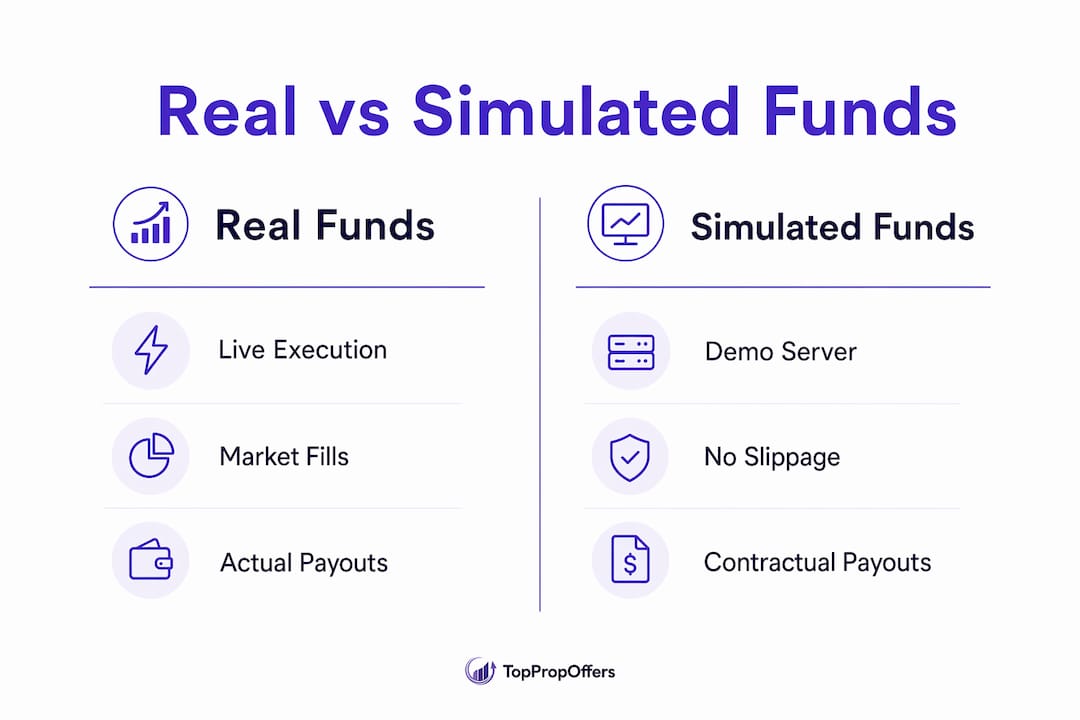
Simulated (demo) funded account: Your account balance is notional. Trades execute on the firm’s internal demo server using live market price feeds, but no order ever reaches an exchange or clearing firm. Fills are instantaneous, slippage is modeled (often inconsistently), and partial fills are rare or absent. The funded account balance is a performance-tracking number, not a real capital allocation. Your payout is a contractual payment the firm makes from its own revenue when your simulated P&L meets the eligibility rules.

Live (real) funded account: Orders route to a live exchange or futures commission merchant (FCM), clear in real markets, and generate actual fills with real slippage, queueing, and partial-fill behavior. The firm carries genuine market exposure on your trades. This model is rare in retail prop trading and is typically reserved for top-performing traders or specialized futures programs.
Hybrid and “livesim” variants sit between these two poles. Some firms mirror profitable trader flow to real markets (A-book routing) while keeping most accounts on simulated ledgers. Others use shadow execution, where a subset of trades is hedged externally while the trader’s dashboard still shows demo fills. Firms label these arrangements inconsistently, which is why reading the contract matters more than reading the marketing page.
One honest signal: some firms explicitly state on their help pages that accounts use demo servers with fictitious funds but that payouts are made in real currency. That kind of clear disclosure is a positive sign, not a warning.
Why the simulated vs real distinction matters for your trading
The execution model affects four things that directly touch your results: fills, payouts, psychology, and taxes.
Execution and slippage
Simulated fills often ignore real-market queueing and partial-fill behavior. A limit order that would partially fill in a live futures market might show a full fill on a demo server. Slippage is modeled differently across firms, and latency effects that would erode a scalping edge in live markets simply do not appear in simulation. If your strategy depends on precise entry timing or thin-margin scalping, your simulated results may not translate to live execution.
Payout mechanics
Your payout is not a share of cleared exchange profits. It is a contractual liability the firm owes you based on simulated performance. The firm pays from its own revenue, which is funded primarily by challenge fees from traders who did not pass. A firm charging a challenge fee with many applicants generates substantial fee revenue to fund payout pools. That model works as long as the firm manages its payout obligations responsibly. If it does not, your simulated profits mean nothing.
Trader psychology and risk management
Knowing your account is simulated can subtly shift your risk appetite. Position sizing discipline, drawdown respect, and emotional control under pressure all tend to be sharper when real capital is at stake. Practicing sound risk management during your challenge and funded phase matters precisely because those habits need to carry over when execution conditions change.
- Simulated fills can make aggressive strategies look more viable than they are.
- Overconfidence built on demo performance is one of the most common reasons traders fail after transitioning to live accounts.
- Treating every funded account as if it were live capital is the discipline that separates consistent earners from one-time passers.
Regulatory and tax considerations (U.S.)
Because most retail prop platforms sell access to a simulated environment rather than studying client capital, they typically fall outside broker-dealer registration requirements and CFTC oversight. You do not receive the protections that apply to a brokerage account. Payouts are generally treated as ordinary income for independent contractors in the U.S., meaning you are responsible for self-employment tax reporting. Consult a qualified tax professional for your specific situation.
One industry study reported that about 14% of applicants pass a challenge and around 7% reach a payout. Those numbers frame the economics clearly: the majority of challenge fee revenue stays with the firm, which is what funds payouts for the minority who succeed.
Pro Tip: Before paying any challenge fee, search for the firm’s payout history on Trustpilot and trader community forums. A firm with hundreds of verified withdrawals over multiple years is a fundamentally different risk than one with a polished website and no payout trail.
How prop firm funding stages work in practice
Most retail prop firms follow a three-stage path. Understanding where you are in that path tells you what the account actually is at each point.
-
Stage 1: Paid evaluation (challenge). You pay an enrollment fee, typically ranging from under $100 to several hundred dollars depending on account size, and trade on a demo server under defined rules. Profit targets, maximum daily drawdown, and overall drawdown limits govern your performance. Passing the challenge is a screening event, not a capital allocation. Compare challenge formats and fee ranges across 1-step, 2-step, and instant funding structures before choosing.
-
Stage 2: Funded (simulated) account with payout eligibility. Once you pass, the firm grants you a larger notional balance and you become eligible to request payouts on a percentage of your simulated profits. The account is still almost always on a demo server. What changes is the contractual relationship: the firm now owes you a payout when you meet the eligibility conditions. Profit splits at this stage are stated by firms and vary depending on their policies and any scaling plan in place.
-
Stage 3: Selective live routing or hybrid allocation. A small number of firms route consistently profitable traders to live capital, either through direct FCM clearing for futures or A-book execution for forex. Live capital is expensive to scale and carries real market risk for the firm, so this transition is selective and criteria-driven. Most traders never reach this stage at retail prop firms, and many firms do not offer it at all.
Typical timelines and costs: A standard 2-step challenge might take several weeks to a couple of months to complete if you trade consistently. Enrollment fees vary widely depending on the firm and account size. Once funded, payout request cycles range from weekly to monthly depending on the firm. The path from first challenge to first payout commonly takes several weeks to a few months when accounting for evaluation time, verification, and payout processing.
How to tell if a prop firm is running simulated execution
You do not have to take a firm’s word for it. Several practical checks let you verify the execution model before you pay a fee.
Slippage and fill tests
Open a small demo account with the firm if available, or review community-reported fills. Place a market order during a moderate-volatility period and compare the fill to the live bid/ask at that moment. On a genuine demo server, fills are often suspiciously clean: no slippage, no partial fills, instant execution regardless of order size. In a live market, the same order would show at least some slippage and occasional partial fills on larger sizes. If every fill is perfect, the account is almost certainly simulated.
Contract and disclosure checks
Read the terms of service carefully before paying. Look for language like “demo account,” “fictitious funds,” “simulated trading environment,” or “notional balance.” These phrases confirm simulated execution and are honest disclosures. Also check for broad discretionary clauses that allow the firm to reject payouts at its own judgment with no defined appeal process. Those clauses are a red flag regardless of execution model.
What to request from a firm before signing up: Ask for a sample payout ledger or anonymized withdrawal confirmation screenshots. Ask whether trades are routed to a live broker or executed internally. Ask which execution provider or FCM the firm uses. A firm with nothing to hide will answer these questions directly. Vague responses, redirects to marketing materials, or claims that execution details are “proprietary” are meaningful signals about how the firm operates.
Pro Tip: Search the firm’s name plus “payout proof” or “withdrawal” on Reddit’s r/Forex and r/FuturesTrading communities. Community-verified withdrawal timelines are the most reliable indicator of whether a firm actually pays, because they come from real traders with no incentive to fabricate.
Operational red flags
- Execution provider is unnamed or described only as “tier-1 liquidity” with no specifics.
- No documented payout history older than 12 months.
- Unlimited discretionary clauses with no defined dispute resolution process.
- Payouts require unusual KYC steps that appear only after profits are earned.
- The firm cannot or will not name the technology or broker infrastructure behind the platform.
How to evaluate any prop firm before you commit
Use this checklist and table to score a firm systematically. No single criterion disqualifies a firm, but weak scores across multiple dimensions should give you pause.
Evaluation checklist:
- Payout history: Are there community-verified withdrawals spanning at least 12 months?
- Contract clarity: Does the agreement define payout eligibility, dispute resolution, and account termination terms without broad discretionary carve-outs?
- Profit split: Is the split clearly stated and does it hold at scale, or does it change under scaling plan conditions?
- Drawdown rules: Are daily and overall drawdown limits defined precisely, and do they apply to floating or closed P&L?
- Funding stage transparency: Does the firm disclose whether the funded account is simulated, hybrid, or live-routed?
- Instrument coverage: Does the firm support the markets you actually trade (forex, futures, crypto)?
- Dispute and resolution record: Are there documented cases of the firm resolving disputes fairly, or a pattern of payout denials?
| Evaluation criterion | What to look for | Why it matters |
|---|---|---|
| Funding stage | Explicit disclosure: demo, hybrid, or live | Sets expectations for execution and payout source |
| Payout model | Instant, weekly, or monthly; request-based vs automatic | Affects cash flow and how quickly you access profits |
| Profit split | Stated percentage at each stage and under scaling | Determines your actual earnings per dollar of simulated P&L |
| Drawdown rules | Floating vs closed P&L; daily vs trailing overall limit | Defines how much room you have to manage positions |
| Account size and leverage | Starting notional balance; max leverage by instrument | Affects position sizing and strategy viability |
| Instrument coverage | Forex pairs, futures contracts, crypto assets | Confirms the firm supports your trading style |
Matching criteria to your trading style: Scalpers need to scrutinize slippage modeling and execution speed claims most carefully, since simulated fills can mask edge-destroying latency. Swing traders care more about overnight holding rules and drawdown calculation methods. Futures traders should ask specifically whether the firm uses FCM clearing or simulated futures execution, since the difference in fill quality is most pronounced in that asset class.
What TopPropOffers review data shows about simulated vs live funding
TopPropOffers reviews 80+ prop firms across forex, futures, and crypto markets, and the pattern across that review pool is consistent: simulated execution is the default model for retail-funded accounts. Genuine live routing to an FCM or A-book execution is the exception, not the rule, and it appears most often in specialized futures programs rather than standard forex challenges.
The review data also shows that payout cadence and transparency vary significantly across firms. Some firms process withdrawals within 24–48 hours of a request. Others operate on monthly cycles with multi-day review windows. The firms with the strongest community trust signals share one trait: they have documented, publicly verifiable payout histories that predate their current marketing campaigns.
| Firm | Review page | Discount code | Key notes from review data |
|---|---|---|---|
| FTMO | TopPropOffers FTMO review | No code available | Established payout history; clear rule documentation; no TopPropOffers discount code |
| Upcomers | TopPropOffers Upcomers review | TOPPROP | Reviewed with payout notes and challenge details on TopPropOffers |
How to use TopPropOffers review pages effectively: Each review page includes current trading rules, drawdown structures, profit split details, and payout notes sourced from community reports and firm disclosures. When you visit a review page, look at the payout section first. Consistent, recent withdrawal confirmations carry more weight than a high profit split percentage.
Pro Tip: Use the 2026 prop firm rankings on TopPropOffers to filter by payout reliability and rule transparency before drilling into individual firm reviews. Starting with reliability-ranked lists saves time and reduces the risk of paying a challenge fee to a firm with a thin payout track record.
For a deeper look at why payouts get rejected and how to protect your funded account, the payout rejection guide on TopPropOffers covers the seven most common reasons traders lose earned profits and how to avoid each one.
Key Takeaways
Most retail prop firm accounts are simulated for execution, but payouts are real contractual obligations funded by the firm’s revenue, and payout history is a stronger predictor of trader outcomes than execution model.
| Point | Details |
|---|---|
| Execution is usually simulated | Most retail-funded accounts run on demo servers; orders do not route to an exchange. |
| Payouts are real but contractual | The firm pays from its balance sheet based on simulated P&L; solvency and policies determine reliability. |
| ~7% of applicants reach a payout | One industry study of hundreds of thousands of accounts showed that about 14% pass the challenge and about 7% actually reach a payout. |
| Verify payout history first | Community-verified withdrawals spanning 12+ months are the most reliable trust signal before paying a fee. |
| TopPropOffers reviews 80+ firms | Use TopPropOffers review pages for FTMO, Upcomers, and others to compare payout data and current rules. |
Why experienced traders stop arguing about demo vs live
The “demo vs live” debate tends to dominate conversations among newer traders. Experienced funded traders largely move past it, and for a practical reason: the execution model does not determine whether you get paid. The firm’s operational integrity does.
Traders who have been through multiple funded programs tend to focus on three things. First, does the firm have a long, verifiable payout record? Not a marketing page with testimonials, but actual community-documented withdrawals with dates and amounts. Second, do the rules allow them to trade their actual edge? A firm with tight drawdown limits and a ban on holding positions overnight is not a good fit for a swing trader, regardless of whether it routes live. Third, is the contract written in plain language with defined dispute resolution? Broad discretionary clauses that let a firm deny payouts without explanation are a structural problem that no profit split percentage compensates for.
There is also a practical skill argument for simulated trading. Using a funded sim account to refine your rule discipline, drawdown management, and position sizing before transitioning to a live account is genuinely useful preparation. The habits you build in a structured, rule-governed environment carry over. The traders who struggle most when they reach live capital are often those who treated their funded sim account as a game rather than as a rehearsal.
If you are preparing for that transition, supplementing your prop firm training with broader risk management principles helps build the mental framework that live execution demands.
Compare verified prop firms on TopPropOffers before paying a fee
Sorting through 80+ prop firms on your own takes time you could spend trading. TopPropOffers does that work for you: every review is updated for 2026 with verified payout data, current drawdown rules, profit split details, and active discount codes.

Start with the review pages for FTMO and Upcomers to see how payout documentation and rule transparency look on a well-reviewed firm. Then use the best prop trading firms guide to compare challenge formats, account sizes, and payout models side by side. Most firms on TopPropOffers accept the discount code TOPPROP for a reduction on enrollment fees. FTMO has no discount code on TopPropOffers; check individual review pages for firm-specific codes before purchasing.
Visit TopPropOffers.com to search by instrument, funding stage, or payout reliability and find the firm that fits your trading style.
Useful resources on TopPropOffers
These TopPropOffers pages give you the most direct path to evaluating execution models and payout reliability across the firms we review.
- FTMO review: Full profile including account sizes, drawdown rules, and payout notes. No discount code available for FTMO on TopPropOffers.
- Upcomers review: Challenge details, payout notes, and reviewer commentary. Use code TOPPROP for a fee discount.
- Best prop firms in 2026: Rankings filtered by payout reliability and rule transparency, updated for 2026.
- Challenge format comparison: Side-by-side breakdown of 1-step, 2-step, and instant funding structures with typical fee ranges.
- Payout rejection guide: The seven most common reasons firms deny payouts and how to protect your earnings.
Always check the individual TopPropOffers review page for a firm’s current discount code before purchasing. Codes change, and the review page reflects the most current offer.
FAQ
Are prop firm accounts real or simulated money?
Most retail prop firm accounts use simulated (demo) execution, meaning trades do not route to a live exchange. Payouts, however, are real money paid from the firm’s balance sheet when you meet the eligibility conditions.
How much does a $10,000 prop firm challenge typically cost?
You pay an enrollment fee, typically ranging from under $100 to several hundred dollars depending on account size. Check individual firm review pages on TopPropOffers for current pricing and any applicable discount codes.
What are the main disadvantages of prop firms?
The primary risks are payout uncertainty if the firm lacks solvency, execution differences between simulated and live markets that can mask strategy weaknesses, and the absence of broker-level regulatory protections since most retail prop platforms operate outside CFTC oversight.
Which prop firms have a verified payout track record?
Firms with long, community-documented payout histories tend to score highest on reliability. TopPropOffers reviews FTMO and Upcomers, among 80+ others, with payout notes and current rule details so you can compare track records before paying a challenge fee.
Does simulated trading at a prop firm prepare you for live markets?
It builds rule discipline and drawdown management habits, but simulated fills can mask execution realities like slippage and partial fills. Treat your funded sim account as structured preparation, not a direct proxy for live performance.
Recommended
- Learn How Prop Firms Really Work | Top Prop Offers
- SuperFunded Prop Trading Firm 2025: Transparent Challenges, Big Discounts & Top Benefits | Top Prop Offers
- Prop Trading Blog: Reviews, Tips & Strategies 2026 | TopPropOffers
- Best Prop Trading Firms 2025 – How to Get a Funded Trading Account | Top Prop Offers